# Four moons worth the trip
The outer solar system keeps its most interesting worlds in orbit around somebody else.
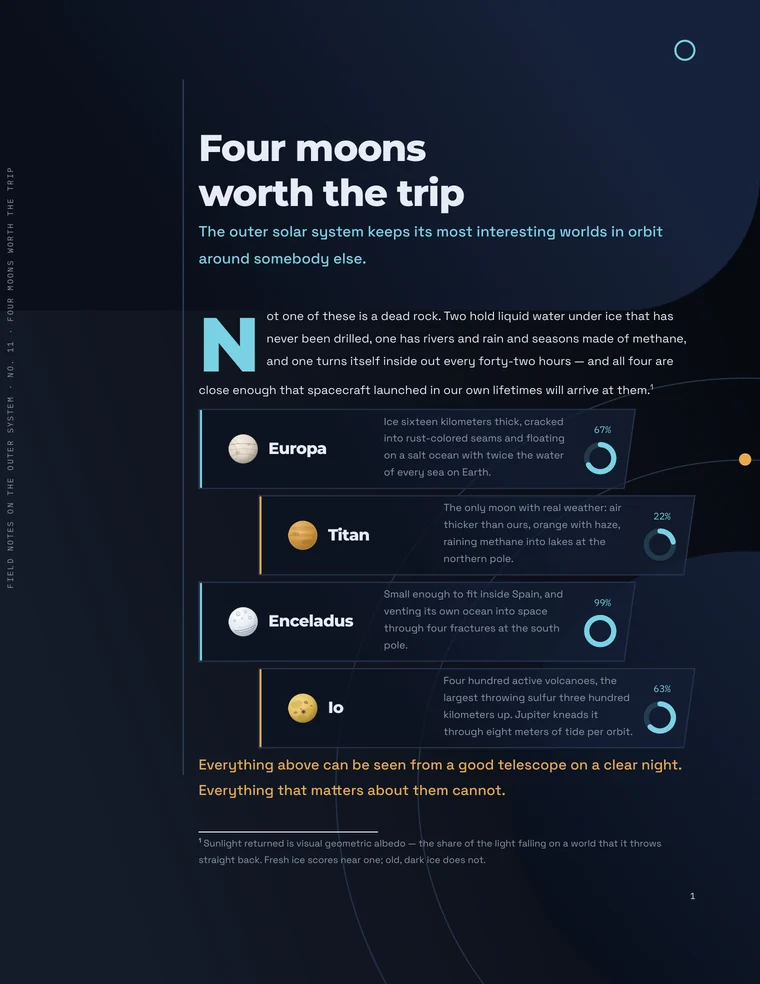
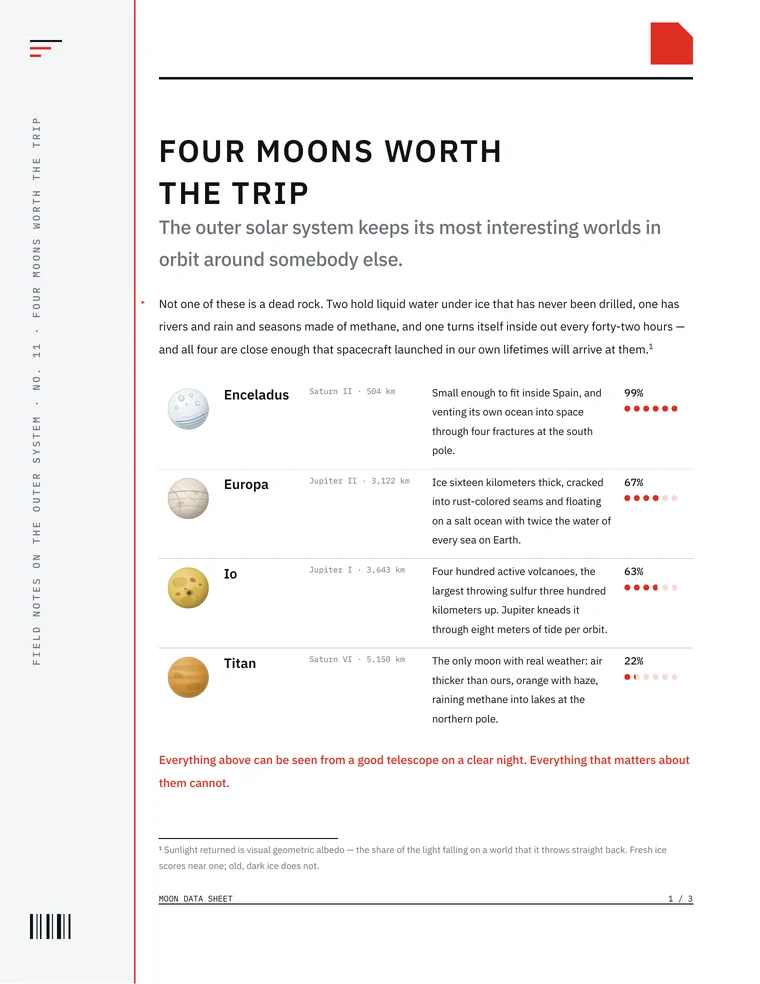
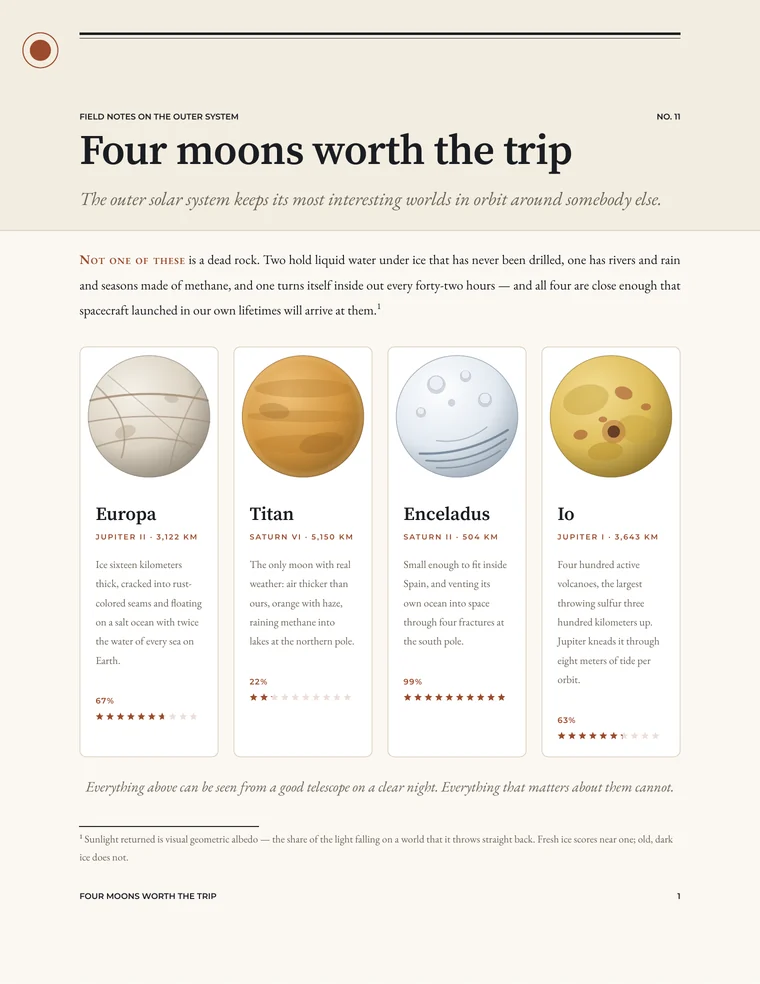
Not one of these is a dead rock. Two hold liquid water under ice that has never been drilled, one has rivers and rain and seasons made of methane, and one turns itself inside out every forty-two hours — and all four are close enough that spacecraft launched in our own lifetimes will arrive at them.[^1]
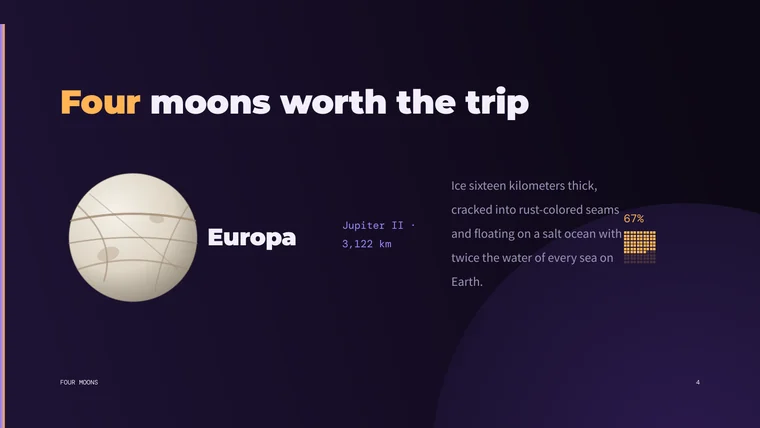
 | Europa | Jupiter II · 3,122 km | Ice sixteen kilometers thick, cracked into rust-colored seams and floating on a salt ocean with twice the water of every sea on Earth. | 67%
 | Titan | Saturn VI · 5,150 km | The only moon with real weather: air thicker than ours, orange with haze, raining methane into lakes at the northern pole. | 22%
 | Enceladus | Saturn II · 504 km | Small enough to fit inside Spain, and venting its own ocean into space through four fractures at the south pole. | 99%
 | Io | Jupiter I · 3,643 km | Four hundred active volcanoes, the largest throwing sulfur three hundred kilometers up. Jupiter kneads it through eight meters of tide per orbit. | 63%
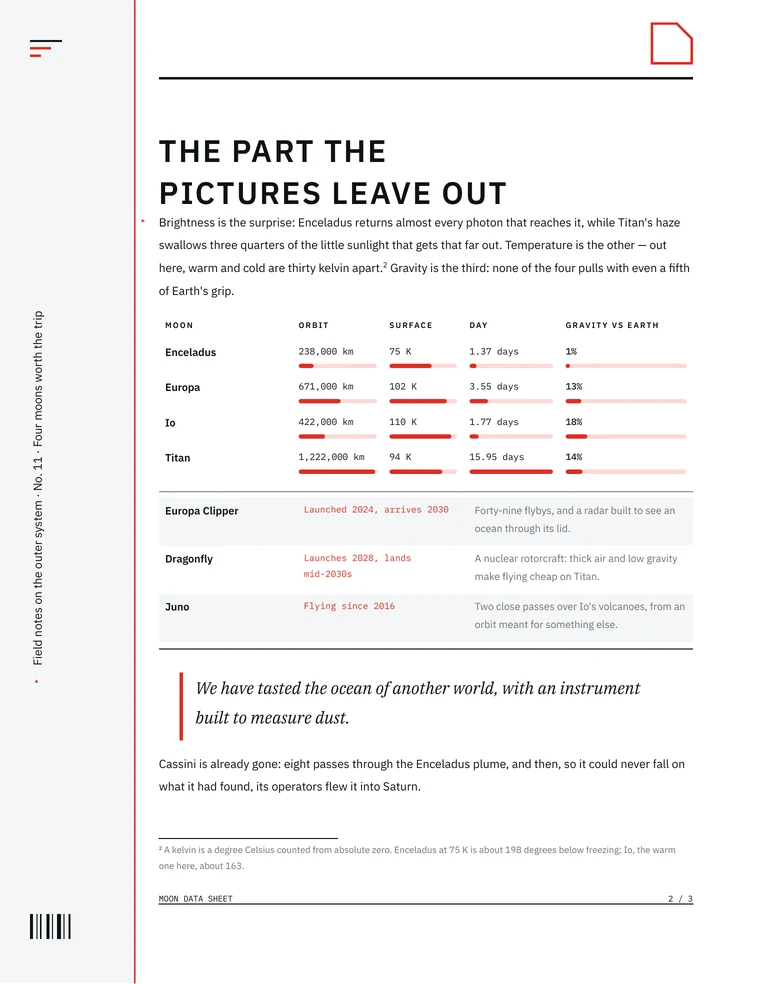
Everything above can be seen from a good telescope on a clear night. Everything that matters about them cannot.
[^1]: Sunlight returned is visual geometric albedo — the share of the light falling on a world that it throws straight back. Fresh ice scores near one; old, dark ice does not.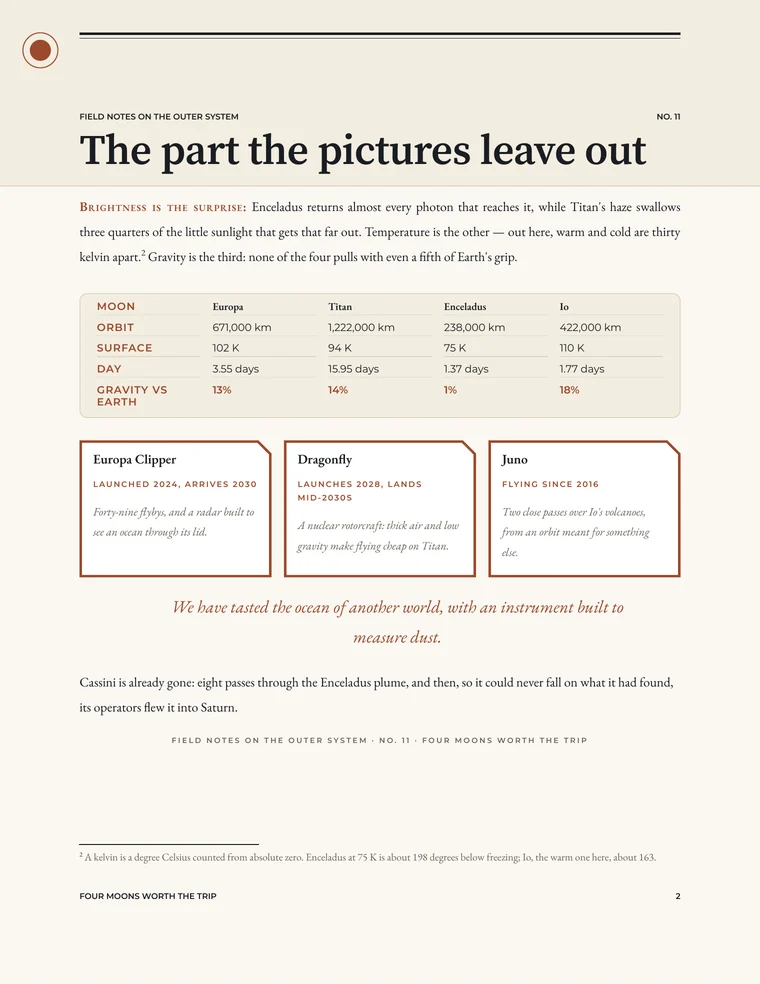
# The part the pictures leave out
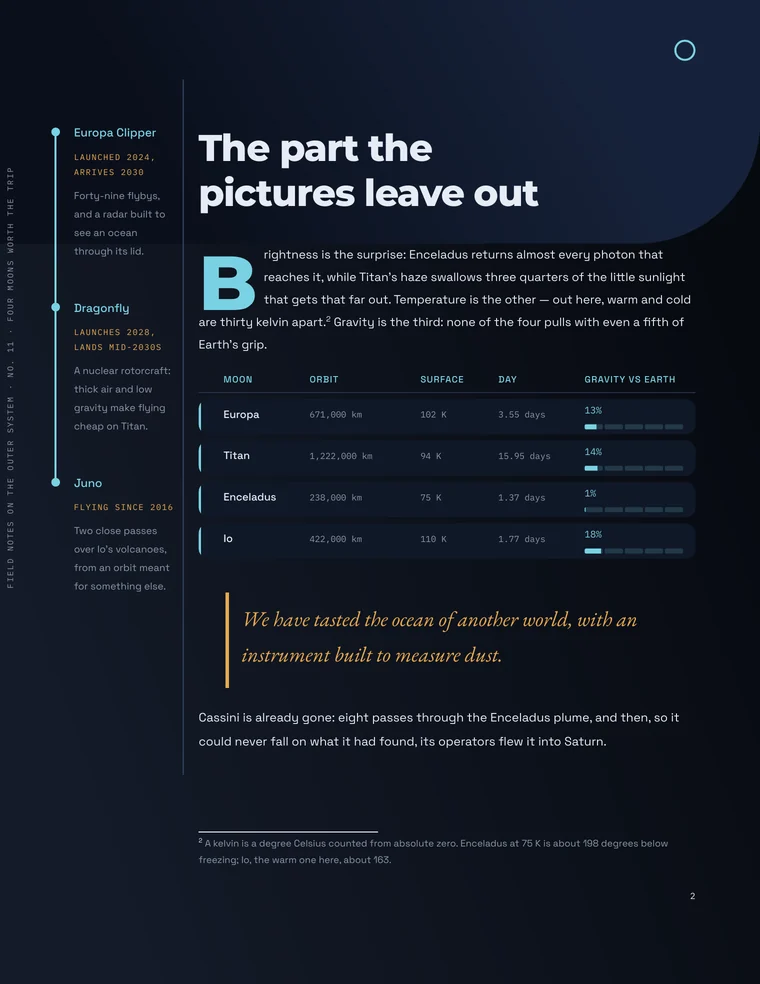
Brightness is the surprise: Enceladus returns almost every photon that reaches it, while Titan's haze swallows three quarters of the little sunlight that gets that far out. Temperature is the other — out here, warm and cold are thirty kelvin apart.[^2] Gravity is the third: none of the four pulls with even a fifth of Earth's grip.

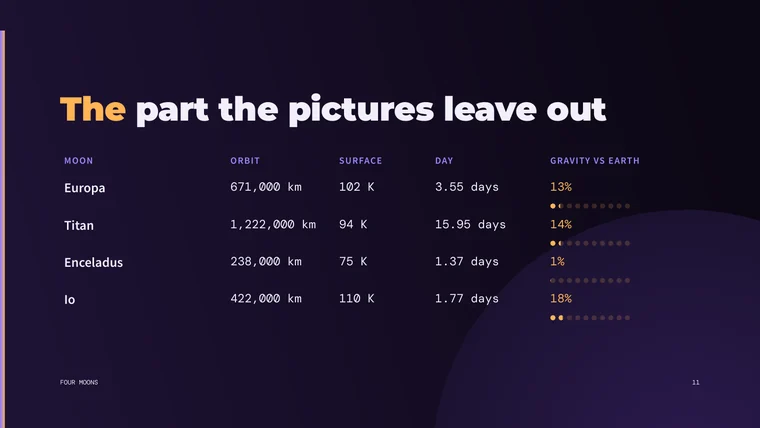
Moon | Orbit | Surface | Day | Gravity vs Earth
Europa | 671,000 km | 102 K | 3.55 days | 13%
Titan | 1,222,000 km | 94 K | 15.95 days | 14%
Enceladus | 238,000 km | 75 K | 1.37 days | 1%
Io | 422,000 km | 110 K | 1.77 days | 18%

Europa Clipper | Launched 2024, arrives 2030 | Forty-nine flybys, and a radar built to see an ocean through its lid.
Dragonfly | Launches 2028, lands mid-2030s | A nuclear rotorcraft: thick air and low gravity make flying cheap on Titan.
Juno | Flying since 2016 | Two close passes over Io's volcanoes, from an orbit meant for something else.

> We have tasted the ocean of another world, with an instrument built to measure dust.

Cassini is already gone: eight passes through the Enceladus plume, and then, so it could never fall on what it had found, its operators flew it into Saturn.

[Stamp] Field notes on the outer system · No. 11 · Four moons worth the trip

[^2]: A kelvin is a degree Celsius counted from absolute zero. Enceladus at 75 K is about 198 degrees below freezing; Io, the warm one here, about 163.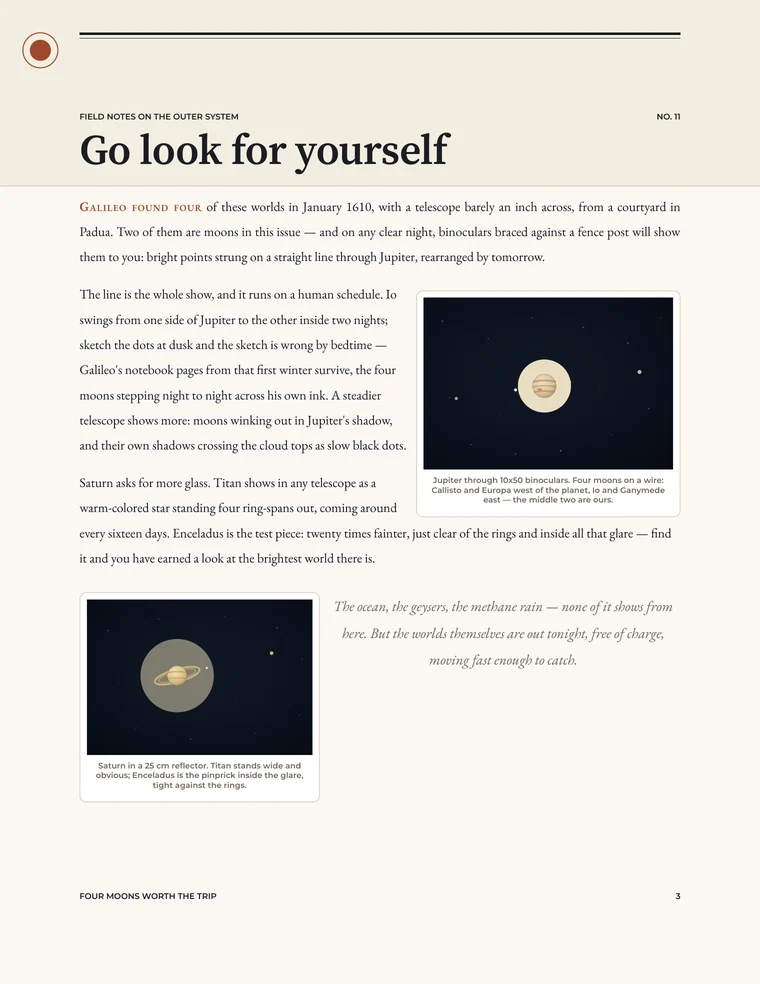
# Go look for yourself
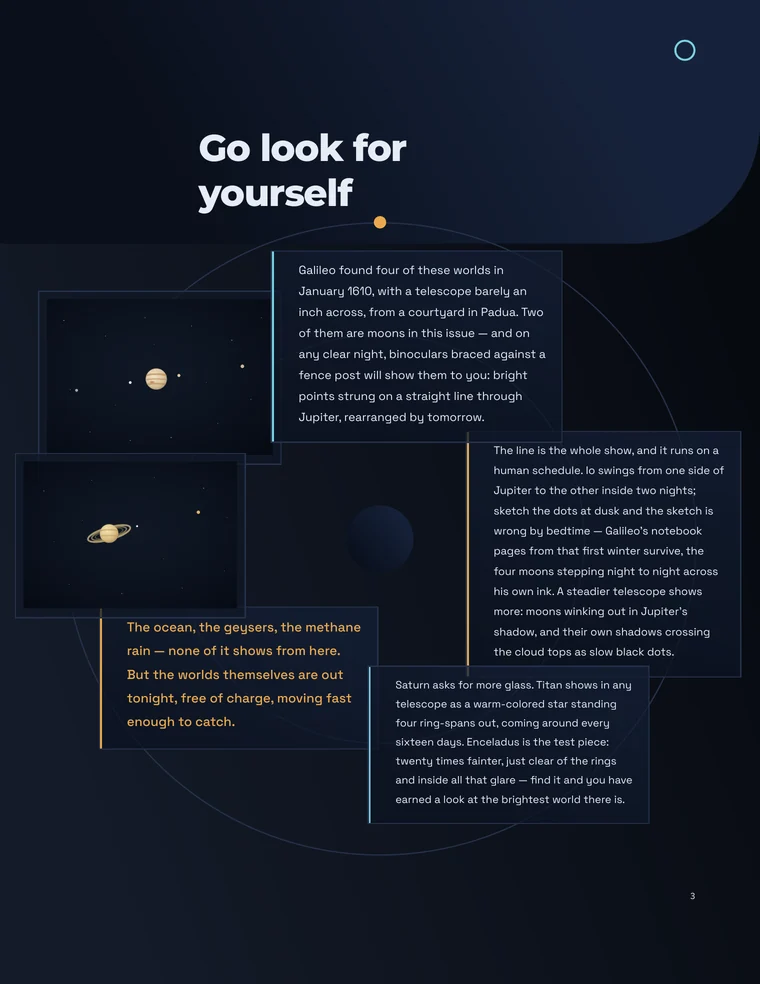
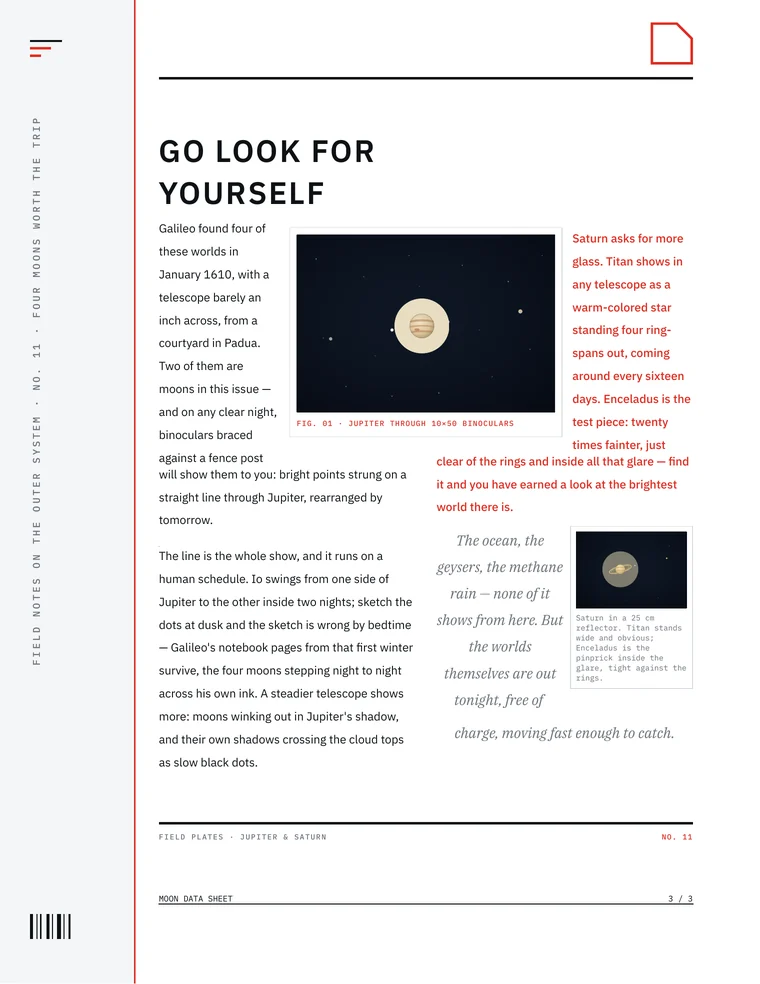
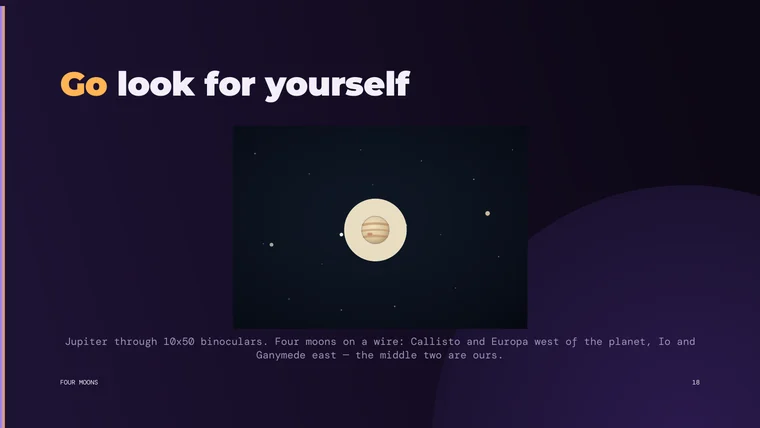
[Spread] Galileo found four of these worlds in January 1610, with a telescope barely an inch across, from a courtyard in Padua. Two of them are moons in this issue — and on any clear night, binoculars braced against a fence post will show them to you: bright points strung on a straight line through Jupiter, rearranged by tomorrow.
[PlateA] 
The line is the whole show, and it runs on a human schedule. Io swings from one side of Jupiter to the other inside two nights; sketch the dots at dusk and the sketch is wrong by bedtime — Galileo's notebook pages from that first winter survive, the four moons stepping night to night across his own ink. A steadier telescope shows more: moons winking out in Jupiter's shadow, and their own shadows crossing the cloud tops as slow black dots.
Saturn asks for more glass. Titan shows in any telescope as a warm-colored star standing four ring-spans out, coming around every sixteen days. Enceladus is the test piece: twenty times fainter, just clear of the rings and inside all that glare — find it and you have earned a look at the brightest world there is.
[PlateB] 
The ocean, the geysers, the methane rain — none of it shows from here. But the worlds themselves are out tonight, free of charge, moving fast enough to catch.A printed field journal
Cream paper, a nameplate under a thick-thin double rule, and the four moons as illustrated cards in a row. Each one's albedo — how much sunlight it throws back — is drawn as a row of stars.
42 lines of content produced all 4 of these — no fonts, no colors, no page setup.