Log InGet OrdStyle

From plain text to beautifully designed documents

One file, one editor: write together in real time, then publish it as a book, a magazine, a slide deck, or a website.

Same content, totally different looks

One Document, Many Designs

A style sets page geometry, typefaces, palette, column structure, and page furniture — so switching styles turns the same document into a printed field journal, a dark cinematic spread, a technical datasheet or a 16:9 slide show, without touching the content. A style lives inside the document, so it travels with the file and is as easy to share as the text itself.

  • Page size, margins, columns, and more come from the style
  • Styles cascade, so you only need to specify changes, and are sharable so you don't have to start from scratch
  • Swap a palette, fonts, or icons or other variables to reskin the whole document
  • Style by position: the first, last or every Nth paragraph of a given context, with no markup in the text
  • Typography can be specified in the style, or go directly in the content

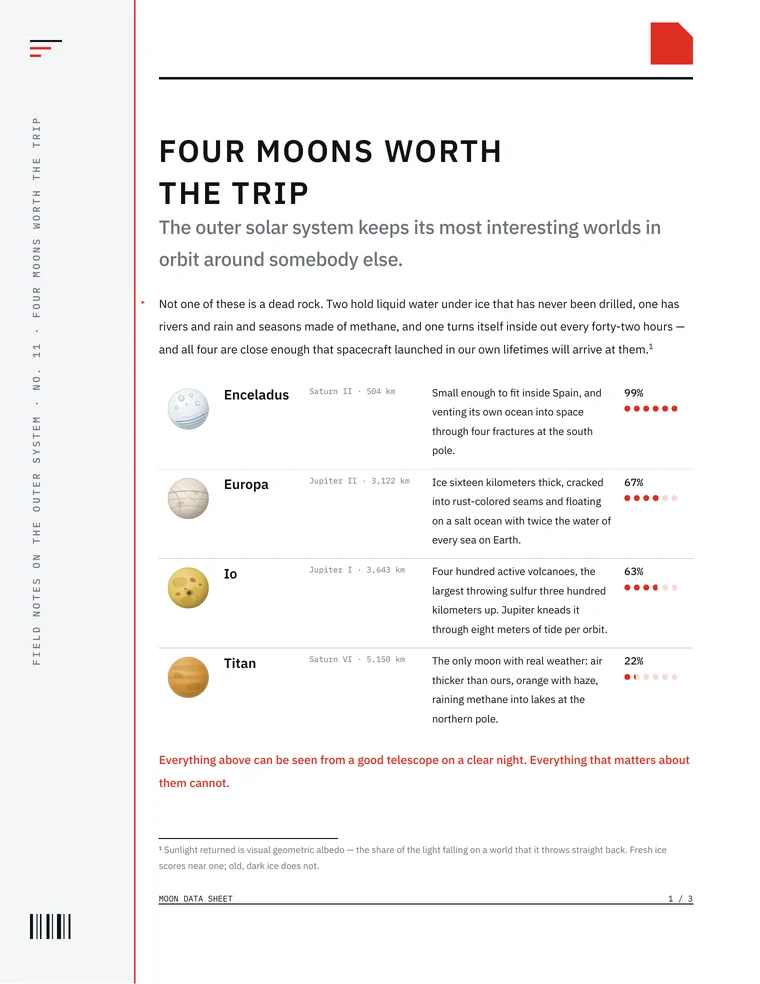
Four styles, four finished documents — and every tab below is the same three pages of the same file. The paper, the typefaces, the way the four moons are laid out, and even how a percentage is drawn all come from the style. The words are identical in each one.

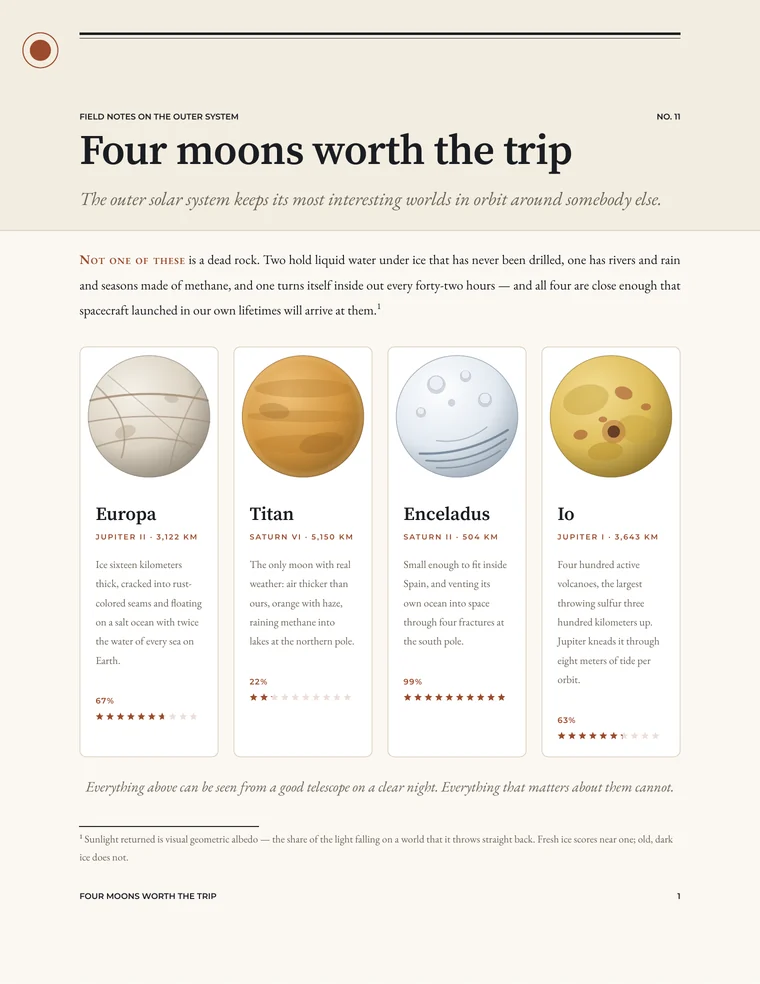
Four Moons Worth the Trip, the observatory design, page 1
# Four moons worth the trip
The outer solar system keeps its most interesting worlds in orbit around somebody else.

Not one of these is a dead rock. Two hold liquid water under ice that has never been drilled, one has rivers and rain and seasons made of methane, and one turns itself inside out every forty-two hours — and all four are close enough that spacecraft launched in our own lifetimes will arrive at them.[^1]

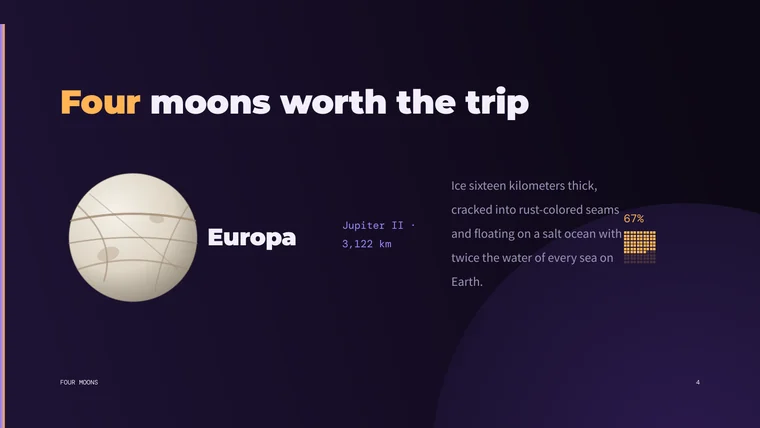
![](assets/g11-europa.svg) | Europa | Jupiter II · 3,122 km | Ice sixteen kilometers thick, cracked into rust-colored seams and floating on a salt ocean with twice the water of every sea on Earth. | 67%
![](assets/g11-titan.svg) | Titan | Saturn VI · 5,150 km | The only moon with real weather: air thicker than ours, orange with haze, raining methane into lakes at the northern pole. | 22%
![](assets/g11-enceladus.svg) | Enceladus | Saturn II · 504 km | Small enough to fit inside Spain, and venting its own ocean into space through four fractures at the south pole. | 99%
![](assets/g11-io.svg) | Io | Jupiter I · 3,643 km | Four hundred active volcanoes, the largest throwing sulfur three hundred kilometers up. Jupiter kneads it through eight meters of tide per orbit. | 63%

Everything above can be seen from a good telescope on a clear night. Everything that matters about them cannot.

[^1]: Sunlight returned is visual geometric albedo — the share of the light falling on a world that it throws straight back. Fresh ice scores near one; old, dark ice does not.
Page 1
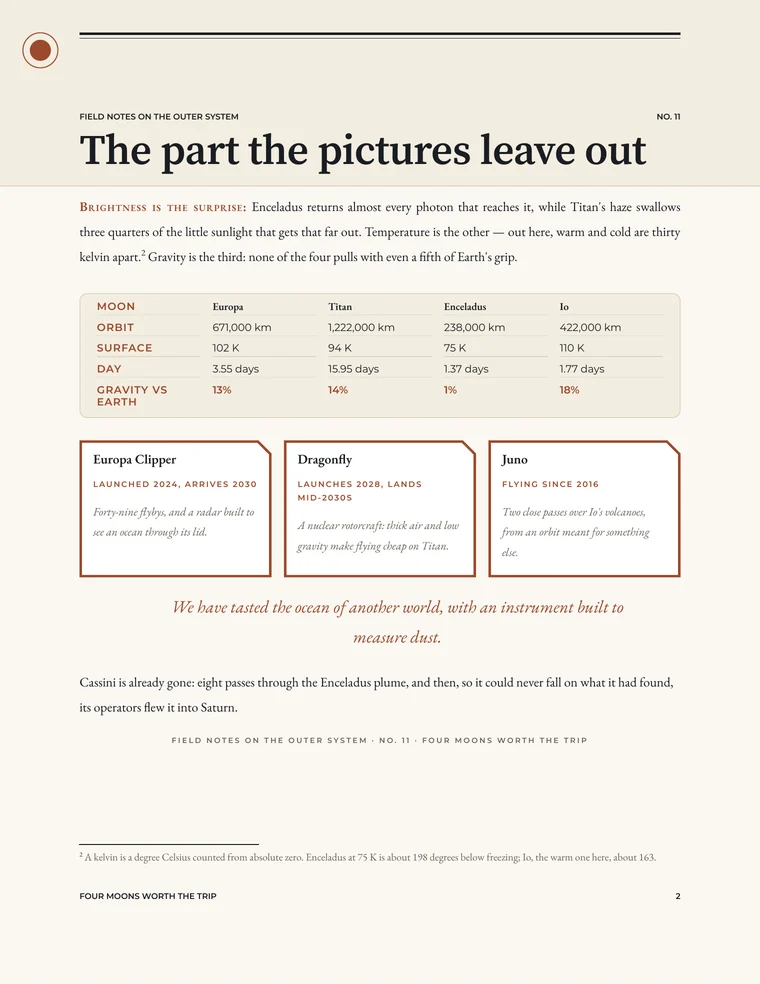
Four Moons Worth the Trip, the observatory design, page 2
# The part the pictures leave out
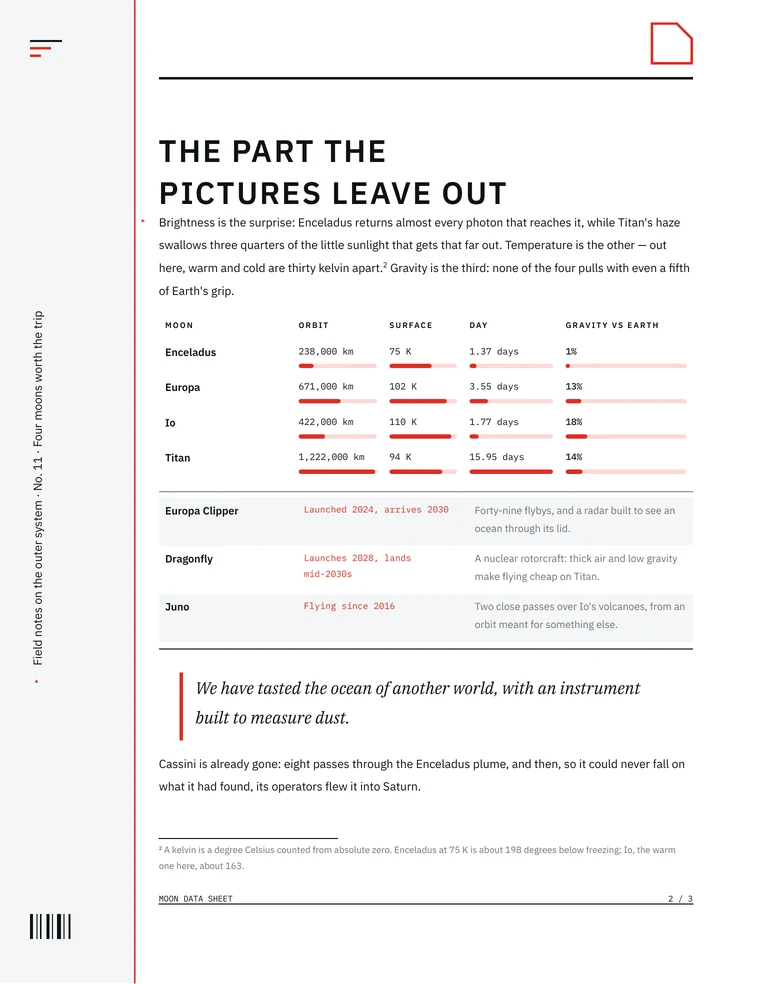
Brightness is the surprise: Enceladus returns almost every photon that reaches it, while Titan's haze swallows three quarters of the little sunlight that gets that far out. Temperature is the other — out here, warm and cold are thirty kelvin apart.[^2] Gravity is the third: none of the four pulls with even a fifth of Earth's grip.

Moon | Orbit | Surface | Day | Gravity vs Earth
Europa | 671,000 km | 102 K | 3.55 days | 13%
Titan | 1,222,000 km | 94 K | 15.95 days | 14%
Enceladus | 238,000 km | 75 K | 1.37 days | 1%
Io | 422,000 km | 110 K | 1.77 days | 18%

Europa Clipper | Launched 2024, arrives 2030 | Forty-nine flybys, and a radar built to see an ocean through its lid.
Dragonfly | Launches 2028, lands mid-2030s | A nuclear rotorcraft: thick air and low gravity make flying cheap on Titan.
Juno | Flying since 2016 | Two close passes over Io's volcanoes, from an orbit meant for something else.

> We have tasted the ocean of another world, with an instrument built to measure dust.

Cassini is already gone: eight passes through the Enceladus plume, and then, so it could never fall on what it had found, its operators flew it into Saturn.

[Stamp] Field notes on the outer system · No. 11 · Four moons worth the trip

[^2]: A kelvin is a degree Celsius counted from absolute zero. Enceladus at 75 K is about 198 degrees below freezing; Io, the warm one here, about 163.
Page 2
Four Moons Worth the Trip, the observatory design, page 3
# Go look for yourself
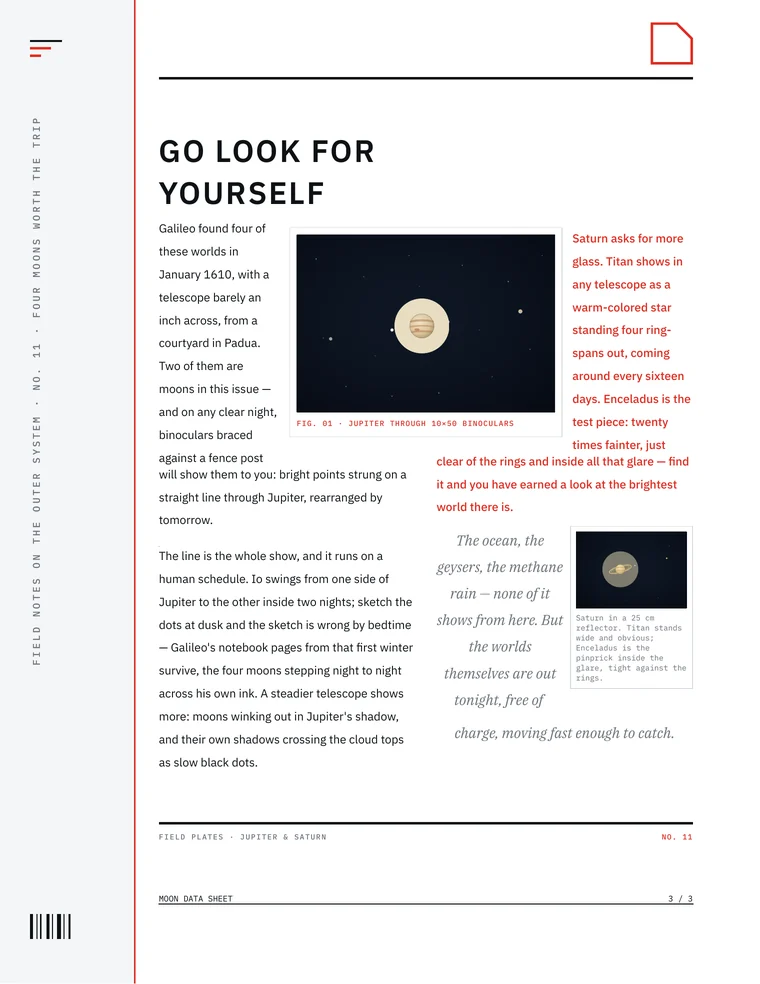
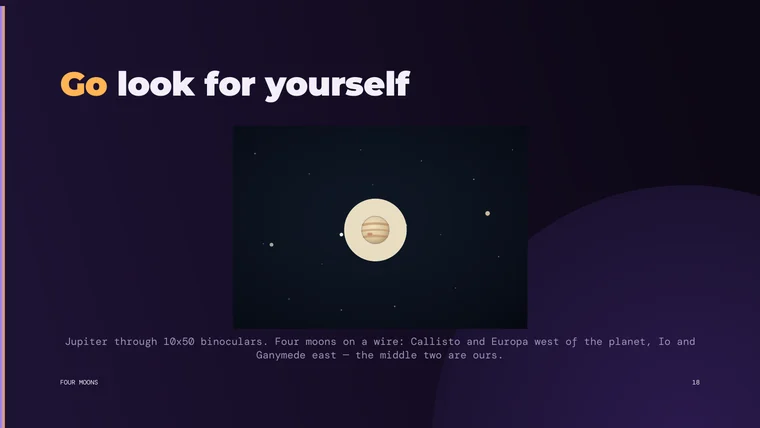
[Spread] Galileo found four of these worlds in January 1610, with a telescope barely an inch across, from a courtyard in Padua. Two of them are moons in this issue — and on any clear night, binoculars braced against a fence post will show them to you: bright points strung on a straight line through Jupiter, rearranged by tomorrow.
[PlateA] ![Jupiter through 10x50 binoculars. Four moons on a wire: Callisto and Europa west of the planet, Io and Ganymede east — the middle two are ours.](assets/g11-jupiter-binoc.svg)
The line is the whole show, and it runs on a human schedule. Io swings from one side of Jupiter to the other inside two nights; sketch the dots at dusk and the sketch is wrong by bedtime — Galileo's notebook pages from that first winter survive, the four moons stepping night to night across his own ink. A steadier telescope shows more: moons winking out in Jupiter's shadow, and their own shadows crossing the cloud tops as slow black dots.
Saturn asks for more glass. Titan shows in any telescope as a warm-colored star standing four ring-spans out, coming around every sixteen days. Enceladus is the test piece: twenty times fainter, just clear of the rings and inside all that glare — find it and you have earned a look at the brightest world there is.
[PlateB] ![Saturn in a 25 cm reflector. Titan stands wide and obvious; Enceladus is the pinprick inside the glare, tight against the rings.](assets/g11-saturn-scope.svg)
The ocean, the geysers, the methane rain — none of it shows from here. But the worlds themselves are out tonight, free of charge, moving fast enough to catch.
Page 3

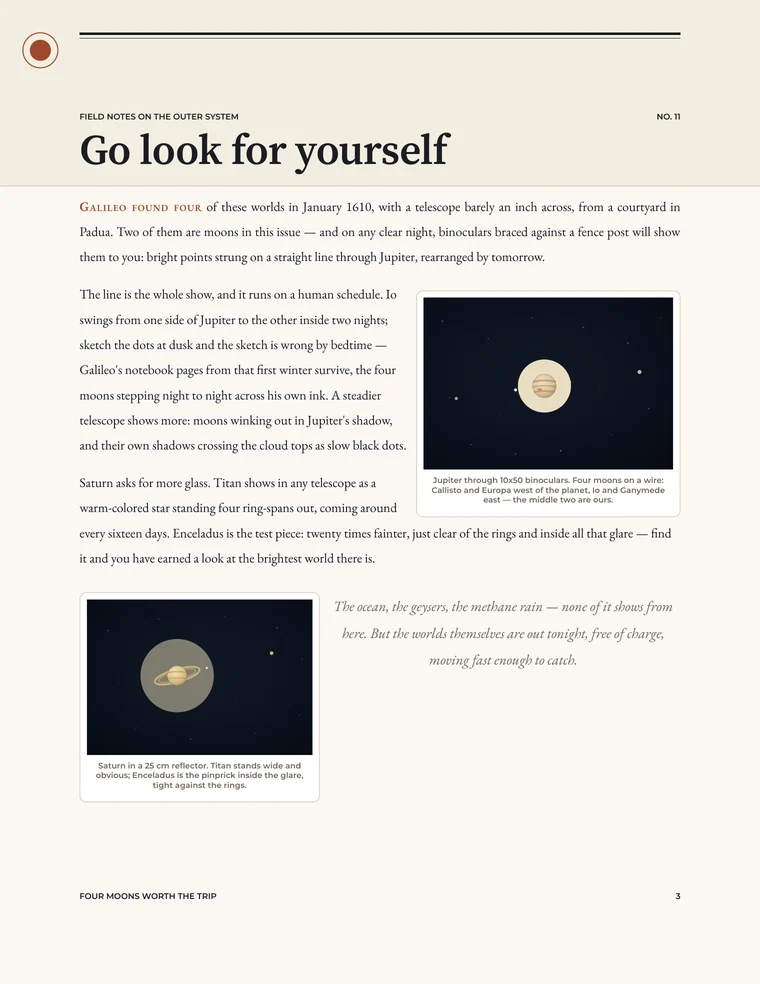
A printed field journal

Cream paper, a nameplate under a thick-thin double rule, and the four moons as illustrated cards in a row. Each one's albedo — how much sunlight it throws back — is drawn as a row of stars.

42 lines of content produced all 4 of these — no fonts, no colors, no page setup.
Paper
Cream, wide margins
Type
Serif, true small caps
Albedo reads as
Star rating
Whole document
3 pages
Open the PDF
Four Moons Worth the Trip, the nocturne design, page 1
# Four moons worth the trip
The outer solar system keeps its most interesting worlds in orbit around somebody else.

Not one of these is a dead rock. Two hold liquid water under ice that has never been drilled, one has rivers and rain and seasons made of methane, and one turns itself inside out every forty-two hours — and all four are close enough that spacecraft launched in our own lifetimes will arrive at them.[^1]

![](assets/g11-europa.svg) | Europa | Jupiter II · 3,122 km | Ice sixteen kilometers thick, cracked into rust-colored seams and floating on a salt ocean with twice the water of every sea on Earth. | 67%
![](assets/g11-titan.svg) | Titan | Saturn VI · 5,150 km | The only moon with real weather: air thicker than ours, orange with haze, raining methane into lakes at the northern pole. | 22%
![](assets/g11-enceladus.svg) | Enceladus | Saturn II · 504 km | Small enough to fit inside Spain, and venting its own ocean into space through four fractures at the south pole. | 99%
![](assets/g11-io.svg) | Io | Jupiter I · 3,643 km | Four hundred active volcanoes, the largest throwing sulfur three hundred kilometers up. Jupiter kneads it through eight meters of tide per orbit. | 63%

Everything above can be seen from a good telescope on a clear night. Everything that matters about them cannot.

[^1]: Sunlight returned is visual geometric albedo — the share of the light falling on a world that it throws straight back. Fresh ice scores near one; old, dark ice does not.
Page 1
Four Moons Worth the Trip, the nocturne design, page 2
# The part the pictures leave out
Brightness is the surprise: Enceladus returns almost every photon that reaches it, while Titan's haze swallows three quarters of the little sunlight that gets that far out. Temperature is the other — out here, warm and cold are thirty kelvin apart.[^2] Gravity is the third: none of the four pulls with even a fifth of Earth's grip.

Moon | Orbit | Surface | Day | Gravity vs Earth
Europa | 671,000 km | 102 K | 3.55 days | 13%
Titan | 1,222,000 km | 94 K | 15.95 days | 14%
Enceladus | 238,000 km | 75 K | 1.37 days | 1%
Io | 422,000 km | 110 K | 1.77 days | 18%

Europa Clipper | Launched 2024, arrives 2030 | Forty-nine flybys, and a radar built to see an ocean through its lid.
Dragonfly | Launches 2028, lands mid-2030s | A nuclear rotorcraft: thick air and low gravity make flying cheap on Titan.
Juno | Flying since 2016 | Two close passes over Io's volcanoes, from an orbit meant for something else.

> We have tasted the ocean of another world, with an instrument built to measure dust.

Cassini is already gone: eight passes through the Enceladus plume, and then, so it could never fall on what it had found, its operators flew it into Saturn.

[Stamp] Field notes on the outer system · No. 11 · Four moons worth the trip

[^2]: A kelvin is a degree Celsius counted from absolute zero. Enceladus at 75 K is about 198 degrees below freezing; Io, the warm one here, about 163.
Page 2
Four Moons Worth the Trip, the nocturne design, page 3
# Go look for yourself
[Spread] Galileo found four of these worlds in January 1610, with a telescope barely an inch across, from a courtyard in Padua. Two of them are moons in this issue — and on any clear night, binoculars braced against a fence post will show them to you: bright points strung on a straight line through Jupiter, rearranged by tomorrow.
[PlateA] ![Jupiter through 10x50 binoculars. Four moons on a wire: Callisto and Europa west of the planet, Io and Ganymede east — the middle two are ours.](assets/g11-jupiter-binoc.svg)
The line is the whole show, and it runs on a human schedule. Io swings from one side of Jupiter to the other inside two nights; sketch the dots at dusk and the sketch is wrong by bedtime — Galileo's notebook pages from that first winter survive, the four moons stepping night to night across his own ink. A steadier telescope shows more: moons winking out in Jupiter's shadow, and their own shadows crossing the cloud tops as slow black dots.
Saturn asks for more glass. Titan shows in any telescope as a warm-colored star standing four ring-spans out, coming around every sixteen days. Enceladus is the test piece: twenty times fainter, just clear of the rings and inside all that glare — find it and you have earned a look at the brightest world there is.
[PlateB] ![Saturn in a 25 cm reflector. Titan stands wide and obvious; Enceladus is the pinprick inside the glare, tight against the rings.](assets/g11-saturn-scope.svg)
The ocean, the geysers, the methane rain — none of it shows from here. But the worlds themselves are out tonight, free of charge, moving fast enough to catch.
Page 3

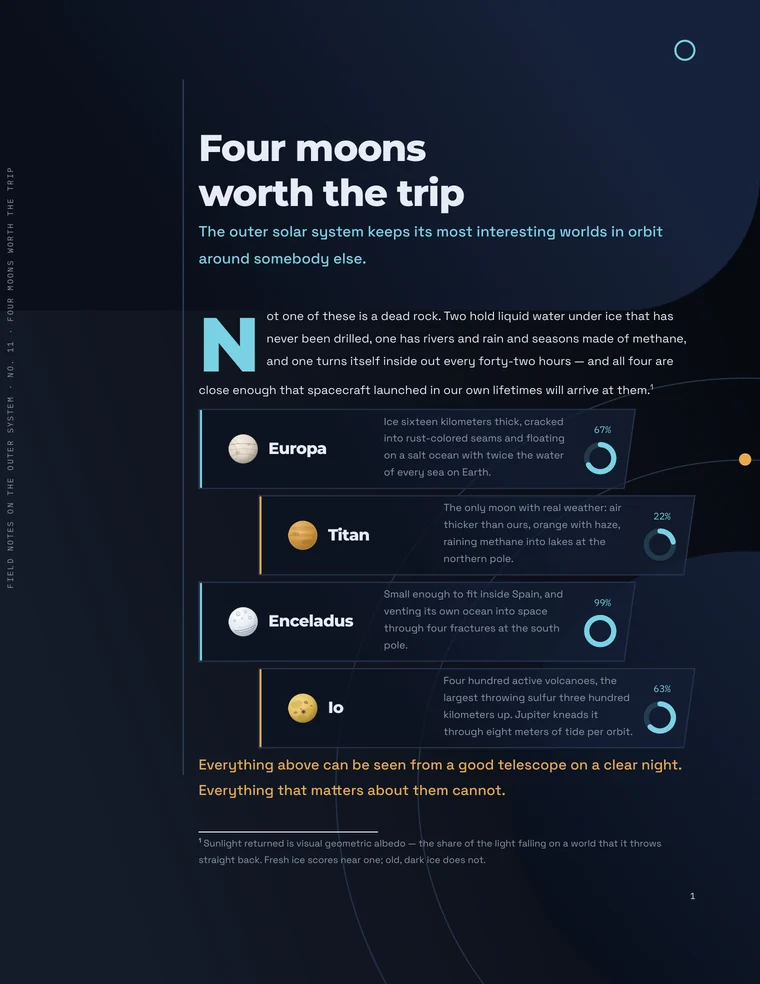
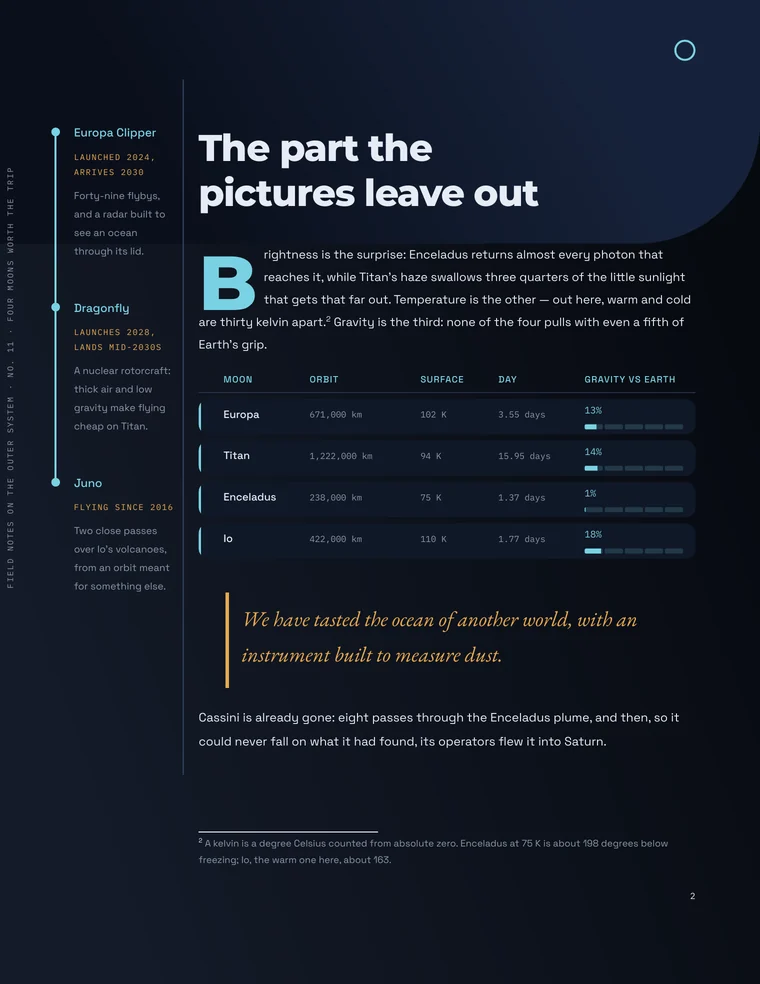
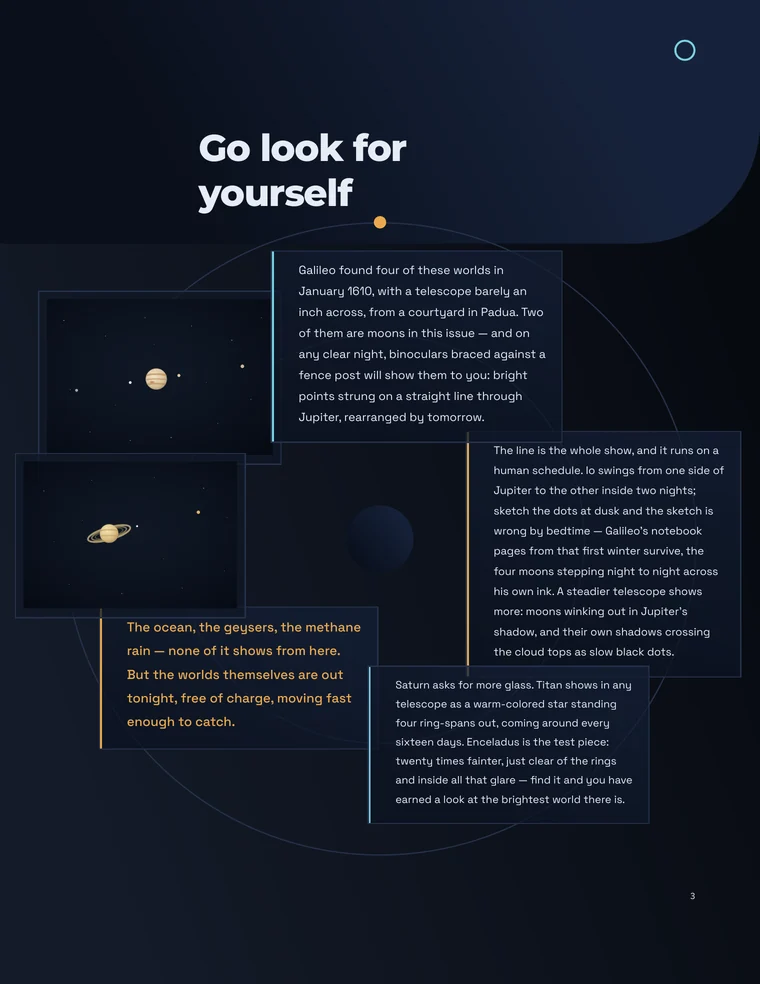
Dark and cinematic

The same three pages on a night gradient: an asymmetric grid, a drop cap opening the text, the moons re-laid as strips down the page, and the albedo redrawn as a ring gauge. The title runs up the spine.

42 lines of content produced all 4 of these — no fonts, no colors, no page setup.
Paper
Night gradient
Type
Display sans
Albedo reads as
Ring gauge
Whole document
3 pages
Open the PDF
Four Moons Worth the Trip, the datasheet design, page 1
# Four moons worth the trip
The outer solar system keeps its most interesting worlds in orbit around somebody else.

Not one of these is a dead rock. Two hold liquid water under ice that has never been drilled, one has rivers and rain and seasons made of methane, and one turns itself inside out every forty-two hours — and all four are close enough that spacecraft launched in our own lifetimes will arrive at them.[^1]

![](assets/g11-europa.svg) | Europa | Jupiter II · 3,122 km | Ice sixteen kilometers thick, cracked into rust-colored seams and floating on a salt ocean with twice the water of every sea on Earth. | 67%
![](assets/g11-titan.svg) | Titan | Saturn VI · 5,150 km | The only moon with real weather: air thicker than ours, orange with haze, raining methane into lakes at the northern pole. | 22%
![](assets/g11-enceladus.svg) | Enceladus | Saturn II · 504 km | Small enough to fit inside Spain, and venting its own ocean into space through four fractures at the south pole. | 99%
![](assets/g11-io.svg) | Io | Jupiter I · 3,643 km | Four hundred active volcanoes, the largest throwing sulfur three hundred kilometers up. Jupiter kneads it through eight meters of tide per orbit. | 63%

Everything above can be seen from a good telescope on a clear night. Everything that matters about them cannot.

[^1]: Sunlight returned is visual geometric albedo — the share of the light falling on a world that it throws straight back. Fresh ice scores near one; old, dark ice does not.
Page 1
Four Moons Worth the Trip, the datasheet design, page 2
# The part the pictures leave out
Brightness is the surprise: Enceladus returns almost every photon that reaches it, while Titan's haze swallows three quarters of the little sunlight that gets that far out. Temperature is the other — out here, warm and cold are thirty kelvin apart.[^2] Gravity is the third: none of the four pulls with even a fifth of Earth's grip.

Moon | Orbit | Surface | Day | Gravity vs Earth
Europa | 671,000 km | 102 K | 3.55 days | 13%
Titan | 1,222,000 km | 94 K | 15.95 days | 14%
Enceladus | 238,000 km | 75 K | 1.37 days | 1%
Io | 422,000 km | 110 K | 1.77 days | 18%

Europa Clipper | Launched 2024, arrives 2030 | Forty-nine flybys, and a radar built to see an ocean through its lid.
Dragonfly | Launches 2028, lands mid-2030s | A nuclear rotorcraft: thick air and low gravity make flying cheap on Titan.
Juno | Flying since 2016 | Two close passes over Io's volcanoes, from an orbit meant for something else.

> We have tasted the ocean of another world, with an instrument built to measure dust.

Cassini is already gone: eight passes through the Enceladus plume, and then, so it could never fall on what it had found, its operators flew it into Saturn.

[Stamp] Field notes on the outer system · No. 11 · Four moons worth the trip

[^2]: A kelvin is a degree Celsius counted from absolute zero. Enceladus at 75 K is about 198 degrees below freezing; Io, the warm one here, about 163.
Page 2
Four Moons Worth the Trip, the datasheet design, page 3
# Go look for yourself
[Spread] Galileo found four of these worlds in January 1610, with a telescope barely an inch across, from a courtyard in Padua. Two of them are moons in this issue — and on any clear night, binoculars braced against a fence post will show them to you: bright points strung on a straight line through Jupiter, rearranged by tomorrow.
[PlateA] ![Jupiter through 10x50 binoculars. Four moons on a wire: Callisto and Europa west of the planet, Io and Ganymede east — the middle two are ours.](assets/g11-jupiter-binoc.svg)
The line is the whole show, and it runs on a human schedule. Io swings from one side of Jupiter to the other inside two nights; sketch the dots at dusk and the sketch is wrong by bedtime — Galileo's notebook pages from that first winter survive, the four moons stepping night to night across his own ink. A steadier telescope shows more: moons winking out in Jupiter's shadow, and their own shadows crossing the cloud tops as slow black dots.
Saturn asks for more glass. Titan shows in any telescope as a warm-colored star standing four ring-spans out, coming around every sixteen days. Enceladus is the test piece: twenty times fainter, just clear of the rings and inside all that glare — find it and you have earned a look at the brightest world there is.
[PlateB] ![Saturn in a 25 cm reflector. Titan stands wide and obvious; Enceladus is the pinprick inside the glare, tight against the rings.](assets/g11-saturn-scope.svg)
The ocean, the geysers, the methane rain — none of it shows from here. But the worlds themselves are out tonight, free of charge, moving fast enough to catch.
Page 3

A technical datasheet

White, red hairlines, all-caps headings and a barcode at the foot. The moons become ledger rows and the albedo becomes a row of red pips — the same number, drawn a third way.

42 lines of content produced all 4 of these — no fonts, no colors, no page setup.
Paper
White, red hairlines
Type
Grotesque, all caps
Albedo reads as
Pip meter
Whole document
3 pages
Open the PDF
Four Moons Worth the Trip, the deck design, slide 4
# Four moons worth the trip
The outer solar system keeps its most interesting worlds in orbit around somebody else.

Not one of these is a dead rock. Two hold liquid water under ice that has never been drilled, one has rivers and rain and seasons made of methane, and one turns itself inside out every forty-two hours — and all four are close enough that spacecraft launched in our own lifetimes will arrive at them.[^1]

![](assets/g11-europa.svg) | Europa | Jupiter II · 3,122 km | Ice sixteen kilometers thick, cracked into rust-colored seams and floating on a salt ocean with twice the water of every sea on Earth. | 67%
![](assets/g11-titan.svg) | Titan | Saturn VI · 5,150 km | The only moon with real weather: air thicker than ours, orange with haze, raining methane into lakes at the northern pole. | 22%
![](assets/g11-enceladus.svg) | Enceladus | Saturn II · 504 km | Small enough to fit inside Spain, and venting its own ocean into space through four fractures at the south pole. | 99%
![](assets/g11-io.svg) | Io | Jupiter I · 3,643 km | Four hundred active volcanoes, the largest throwing sulfur three hundred kilometers up. Jupiter kneads it through eight meters of tide per orbit. | 63%

Everything above can be seen from a good telescope on a clear night. Everything that matters about them cannot.

[^1]: Sunlight returned is visual geometric albedo — the share of the light falling on a world that it throws straight back. Fresh ice scores near one; old, dark ice does not.
Slide 4
Four Moons Worth the Trip, the deck design, slide 11
# The part the pictures leave out
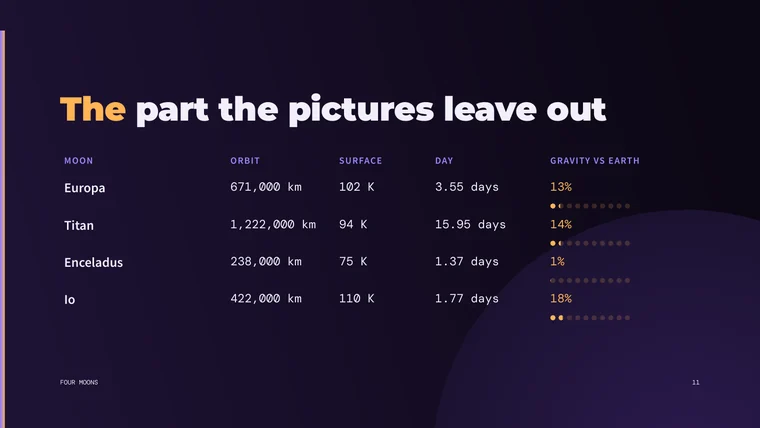
Brightness is the surprise: Enceladus returns almost every photon that reaches it, while Titan's haze swallows three quarters of the little sunlight that gets that far out. Temperature is the other — out here, warm and cold are thirty kelvin apart.[^2] Gravity is the third: none of the four pulls with even a fifth of Earth's grip.

Moon | Orbit | Surface | Day | Gravity vs Earth
Europa | 671,000 km | 102 K | 3.55 days | 13%
Titan | 1,222,000 km | 94 K | 15.95 days | 14%
Enceladus | 238,000 km | 75 K | 1.37 days | 1%
Io | 422,000 km | 110 K | 1.77 days | 18%

Europa Clipper | Launched 2024, arrives 2030 | Forty-nine flybys, and a radar built to see an ocean through its lid.
Dragonfly | Launches 2028, lands mid-2030s | A nuclear rotorcraft: thick air and low gravity make flying cheap on Titan.
Juno | Flying since 2016 | Two close passes over Io's volcanoes, from an orbit meant for something else.

> We have tasted the ocean of another world, with an instrument built to measure dust.

Cassini is already gone: eight passes through the Enceladus plume, and then, so it could never fall on what it had found, its operators flew it into Saturn.

[Stamp] Field notes on the outer system · No. 11 · Four moons worth the trip

[^2]: A kelvin is a degree Celsius counted from absolute zero. Enceladus at 75 K is about 198 degrees below freezing; Io, the warm one here, about 163.
Slide 11
Four Moons Worth the Trip, the deck design, slide 18
# Go look for yourself
[Spread] Galileo found four of these worlds in January 1610, with a telescope barely an inch across, from a courtyard in Padua. Two of them are moons in this issue — and on any clear night, binoculars braced against a fence post will show them to you: bright points strung on a straight line through Jupiter, rearranged by tomorrow.
[PlateA] ![Jupiter through 10x50 binoculars. Four moons on a wire: Callisto and Europa west of the planet, Io and Ganymede east — the middle two are ours.](assets/g11-jupiter-binoc.svg)
The line is the whole show, and it runs on a human schedule. Io swings from one side of Jupiter to the other inside two nights; sketch the dots at dusk and the sketch is wrong by bedtime — Galileo's notebook pages from that first winter survive, the four moons stepping night to night across his own ink. A steadier telescope shows more: moons winking out in Jupiter's shadow, and their own shadows crossing the cloud tops as slow black dots.
Saturn asks for more glass. Titan shows in any telescope as a warm-colored star standing four ring-spans out, coming around every sixteen days. Enceladus is the test piece: twenty times fainter, just clear of the rings and inside all that glare — find it and you have earned a look at the brightest world there is.
[PlateB] ![Saturn in a 25 cm reflector. Titan stands wide and obvious; Enceladus is the pinprick inside the glare, tight against the rings.](assets/g11-saturn-scope.svg)
The ocean, the geysers, the methane rain — none of it shows from here. But the worlds themselves are out tonight, free of charge, moving fast enough to catch.
Slide 18

The same document, presented

A fourth style turns the three pages into a 16:9 deck with its own violet-and-amber identity. The four cards arrive one slide at a time, and the albedo becomes an amber waffle.

42 lines of content produced all 4 of these — no fonts, no colors, no page setup.
Page
16:9 slides
Type
Heavy display over mono
Albedo reads as
Waffle
Whole deck
23 slides
Open the PDF

See all 36 documents in the gallery

Book apparatus, typeset for you

Typesetting for Publication

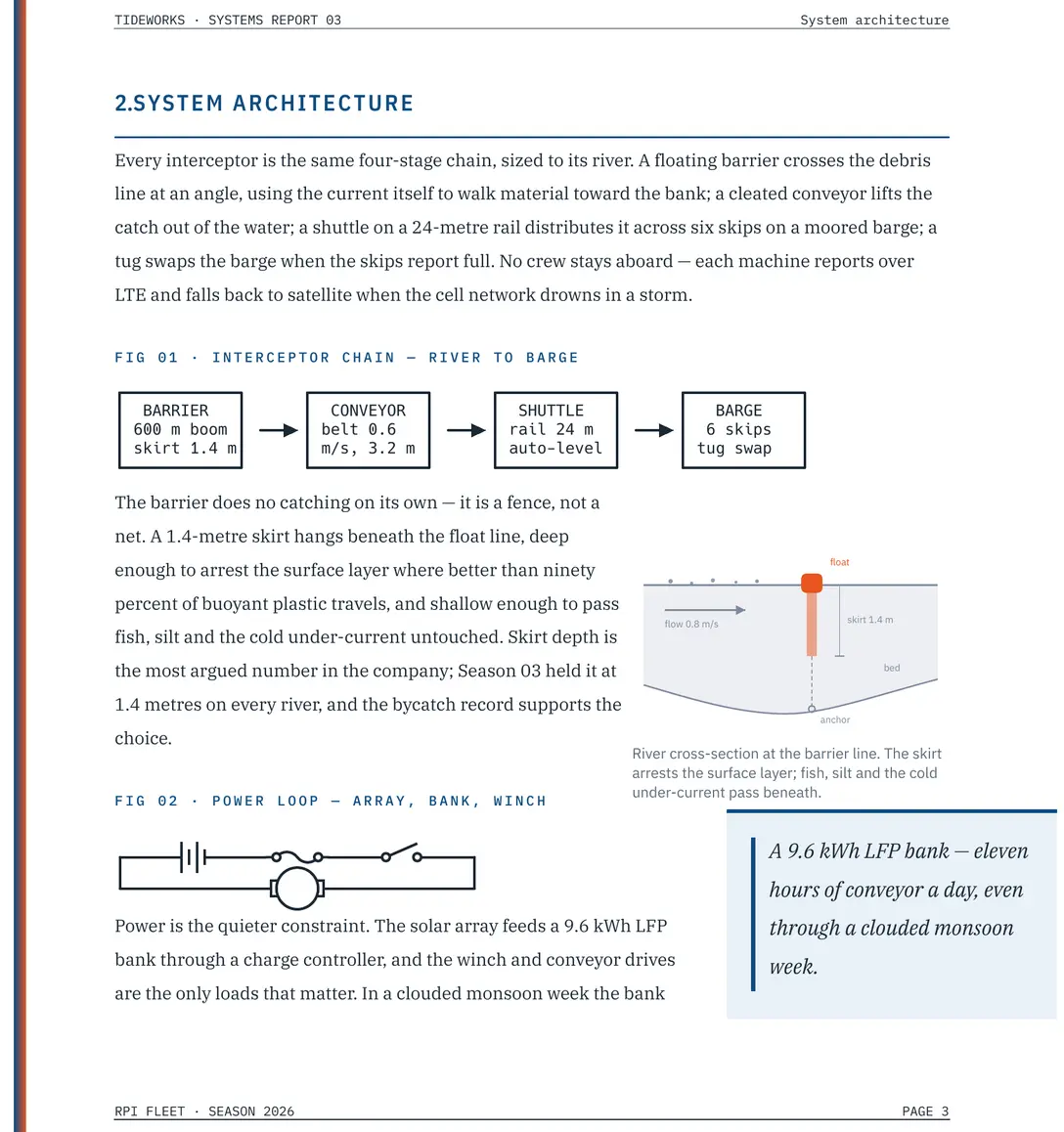
Write an entire book in plain text and let the typesetting engine do the layout: a full column engine, figures with captions and cross-references, and the front and back matter a real book needs.

  • Column engine: balancing, spans, unequal column widths, column bleed, decorated style-driven regions
  • Figures can float with text wrapping around them, run full-bleed, take styled captions and frames, and can be referenced by number
  • Footnotes, endnotes, custom index entries, table of contents, drop caps
  • Regions can place text anywhere on the page: margin notes, sidebars, spine labels and more
  • Math blocks, fractions, leaders, horizontal rules and ornaments
A page of a systems report: running head, body text flowing around a captioned cross-section figure, a labeled circuit diagram, a pull quote and a folio
Charts, circuits, diagrams, formulas, and code — all from plain text

Data, Diagrams & Live Figures

The style chooses how each shape of data is laid out, and every figure is generated from the plain text. A chart reads the table above it, a formula cell recalculates as you edit, circuits and diagrams render from their text, and an embedded Python script runs when the document renders — so nothing is a stale screenshot.

  • Lay out content and data in many presentation forms: stat bands, indicator cards, photo cards, ledgers and leaders, splits and stacks
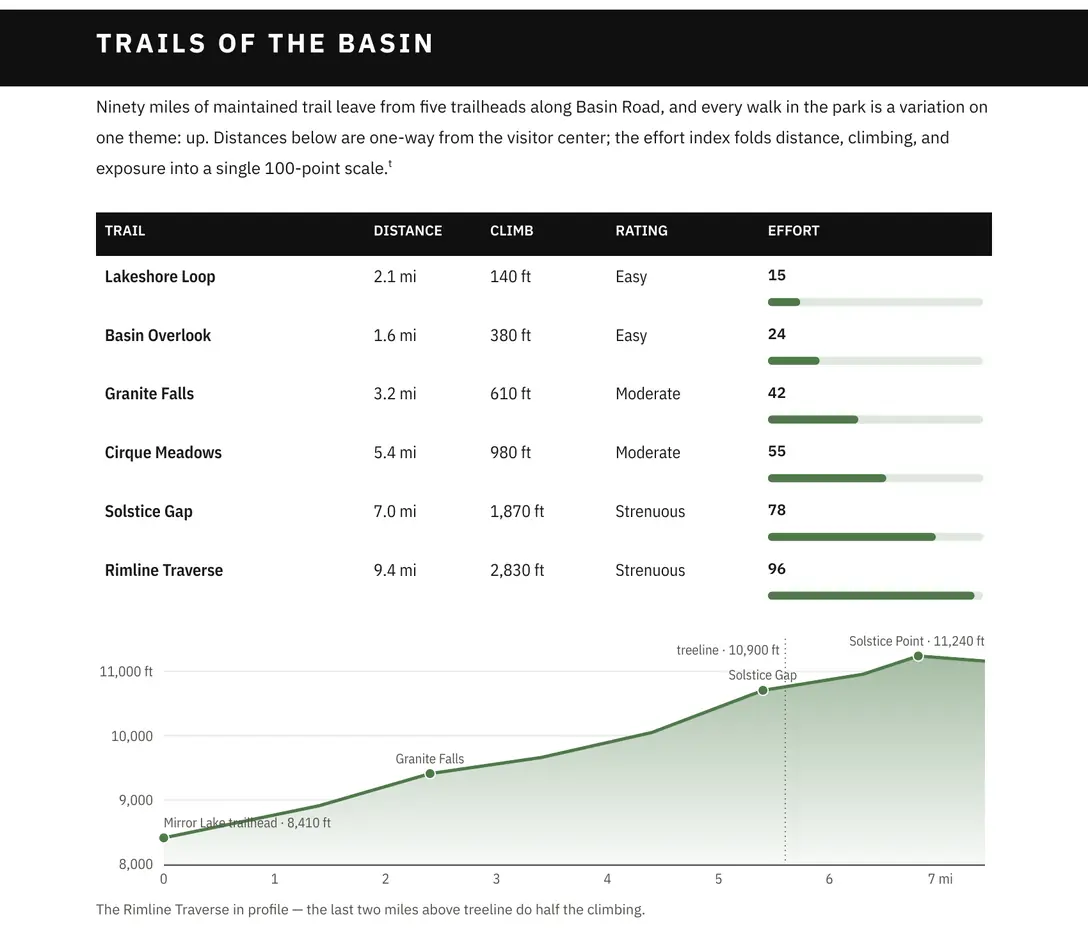
  • Charts are fed by tables in the document: tag a column [Bar], [Line], [Area], [Pie] or [Donut], edit the numbers, and the chart redraws
  • Micro-graphics draw from plain data: rings, gauges, dots, pictograms, batteries, waffles, bullets, ranges
  • Spreadsheet formulas in table cells — SUM, AVERAGE, IF and 27 more; the table is recalculated and resized as you edit
  • You can generate circuit schematics and diagrams from plain text fenced blocks
  • Python scripts embedded in the document take input from the document and run at render time to draw figures
  • Code blocks display with syntax highlighting — Python, C++, Rust, SQL, JSON and dozens more — plus typeset math blocks
A trail table whose effort column renders as inline bar meters, above an elevation profile chart with named points and a treeline reference line
Your network, your server, your files

Real-Time Collaboration Without the Cloud

Any copy of the program can run its own server with its own folder of documents, or quickly share a single document. Everyone can edit at once, each with the permissions you give them, on a server you control.

  • See every collaborator's color-coded cursor live — click a name to follow that user, or spotlight yours to be followed
  • True semantic moves: reorganize a chapter while someone edits inside it — their edits follow the moved text
  • Each change carries its intent. When edits collide, a fixed set of rules merges intents to arrive at identical copies
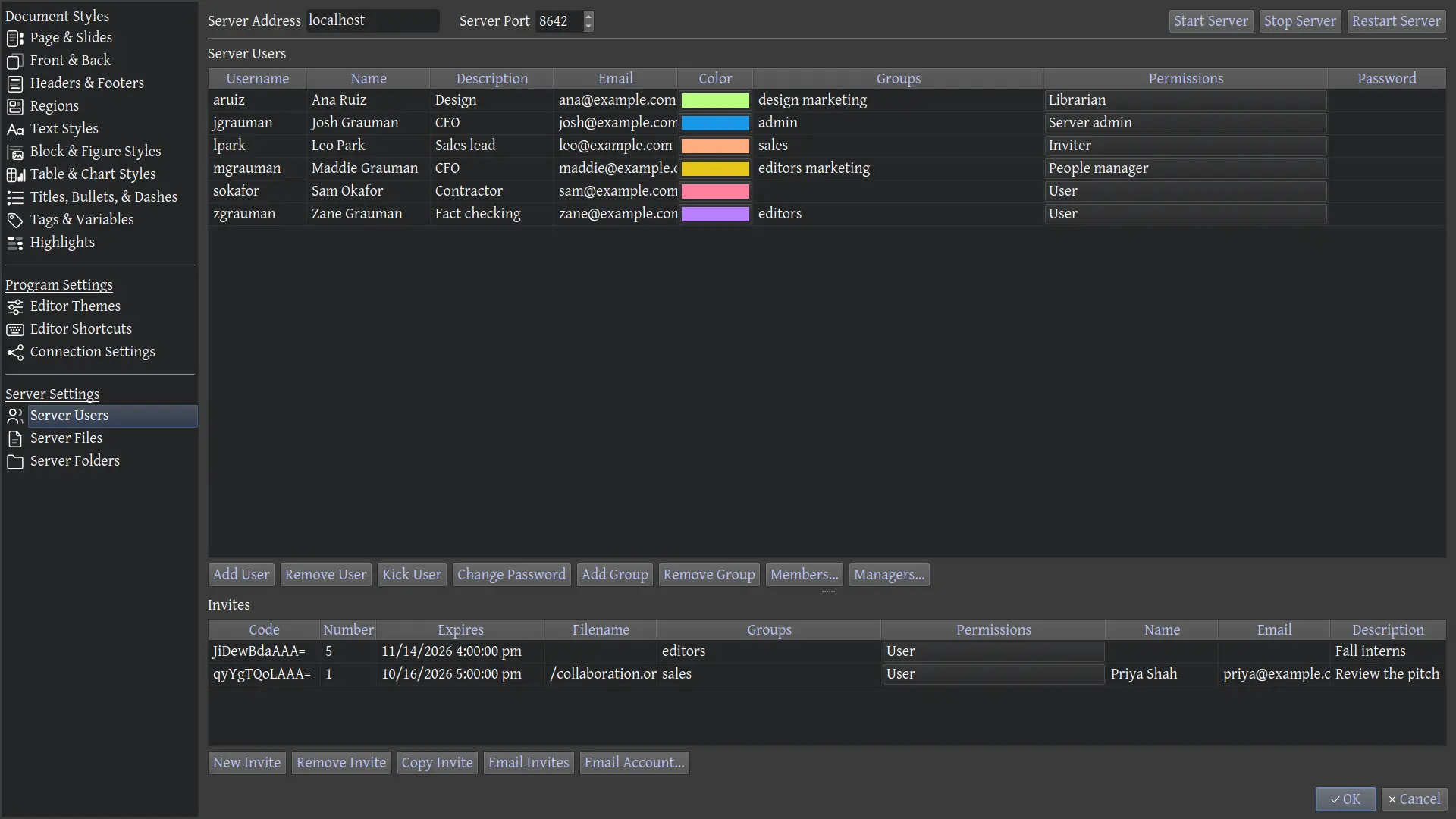
  • Set up and run a server from inside the program: start it, add users, and change permissions
  • Encrypted (TLS) connections; passwords are stored only as salted hashes
The server settings page: Start, Stop and Restart Server buttons beside an address and port, a table of six users with the color each one edits in, their groups and server roles from Server admin to User, and two open invites below it
Set up permissions for your team's workflow

Comments, Suggestions & Review

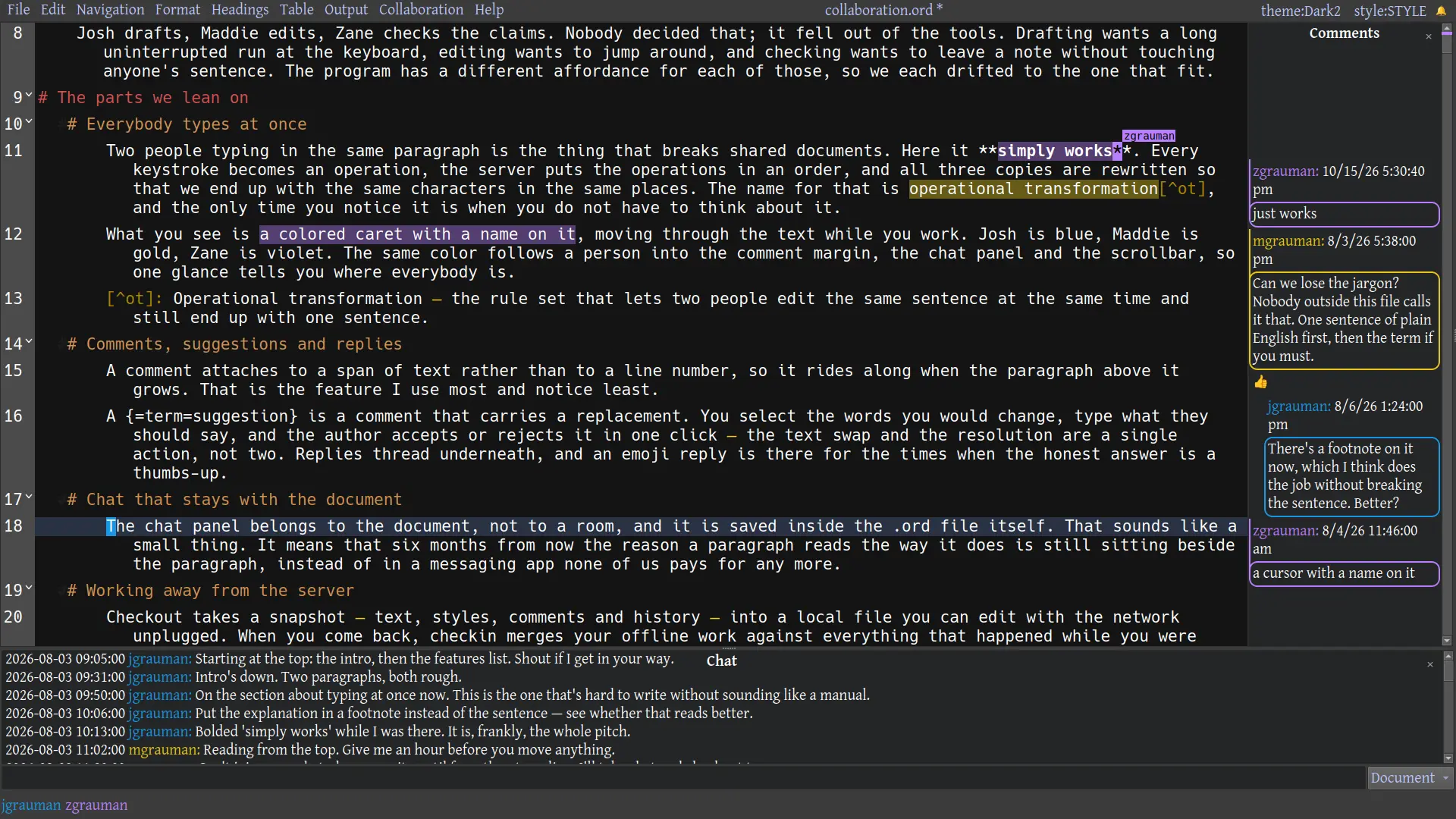
A complete review system: comments with threaded replies, and suggestions that propose new text for someone to accept or reject. Comments stay attached through moves, merges, and offline checkins.

  • Inline comments attached to text ranges
  • Suggestions: select text, propose a replacement, and a moderator can accept or reject it
  • Threaded replies for discussions
  • Comments survive moves, merges, and offline checkins
  • Document-wide chats stored with the document
  • Group chats, private messages, with @mentions and notifications
A document with a collaborator's name-tagged caret in the text and a suggestion of new wording waiting in the comment margin beside threaded comments and an emoji reply, with the document chat docked along the bottom
Work anywhere, merge when ready, roll back anything

Offline-First, With Every Version Kept

Local-first architecture means the editor is fully functional without a network. Check out a document, edit offline for a week, check in — and your changes merge cleanly with everyone's server edits, comments included. Versions run alongside that: save a named version whenever a draft is worth keeping, put it side by side with the document as it stands now, and take back all of it or only the changes you tick.

  • Full functionality without network
  • Checkout / checkin workflow with clean merges on return
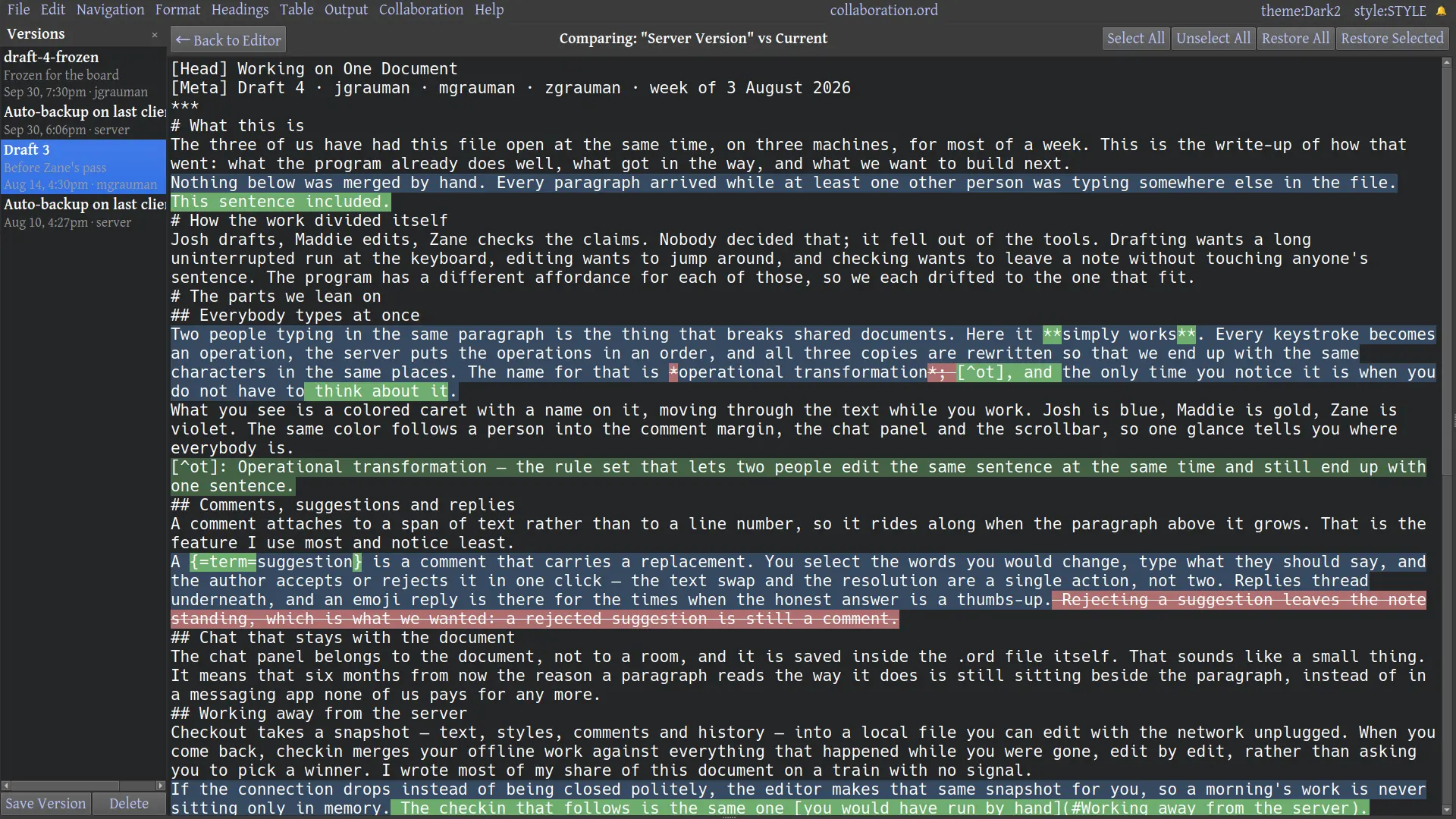
  • Save a named version at any point — a full snapshot, history and styles included
  • Compare a saved version against your current text, change by change
  • Restore the whole version or just the changes you select, or roll the document back to any earlier point in its history
  • A backup is taken before every restore, so rolling back is itself reversible
  • Full undo history — every change and who made it
The version comparison view: named versions and automatic backups listed on the left, and a saved draft diffed against the current document with added and removed passages highlighted, beside Restore All and Restore Selected buttons
Print, slides, and private notes from one document

Slides, In Sync

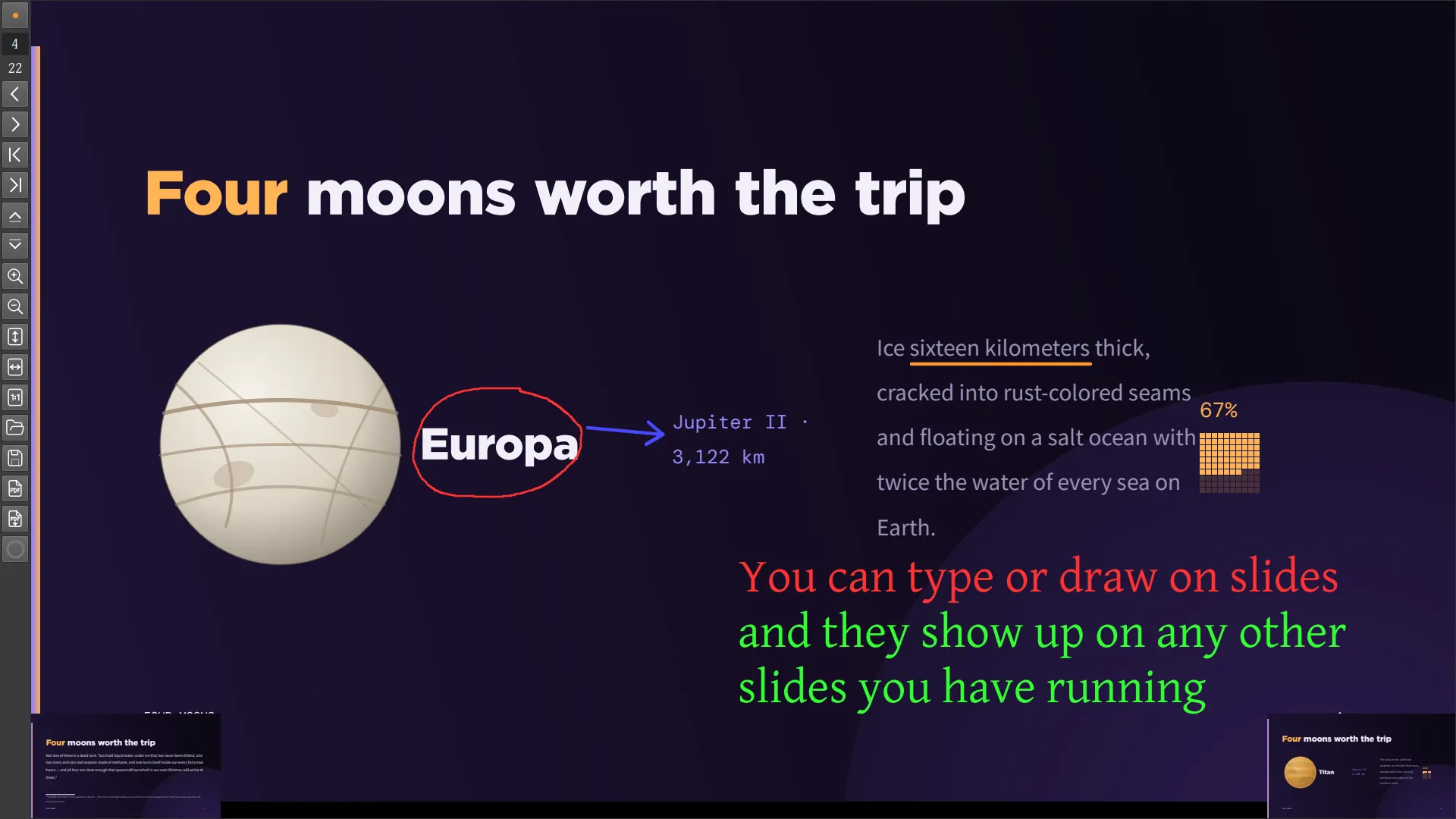
One document gives you a print edition and a slide deck from the same text. Slide windows stay in sync: draw on one screen while another displays it — with private presenter notes only you can see.

  • In-sync slide views: draw on one, display on another
  • Hand-drawn notes and annotations can be saved and restored with the PDF
  • Private presenter notes from the same document
  • Built-in recording
  • Outline-driven slides with flexible slide-break modes
  • Full-screen presentation support
A slide being presented and drawn on live — a moon circled in red with a hand-written note beside it — while two other slide windows along the bottom edge show the same deck in sync
One file that is the whole truth

A Format You Own

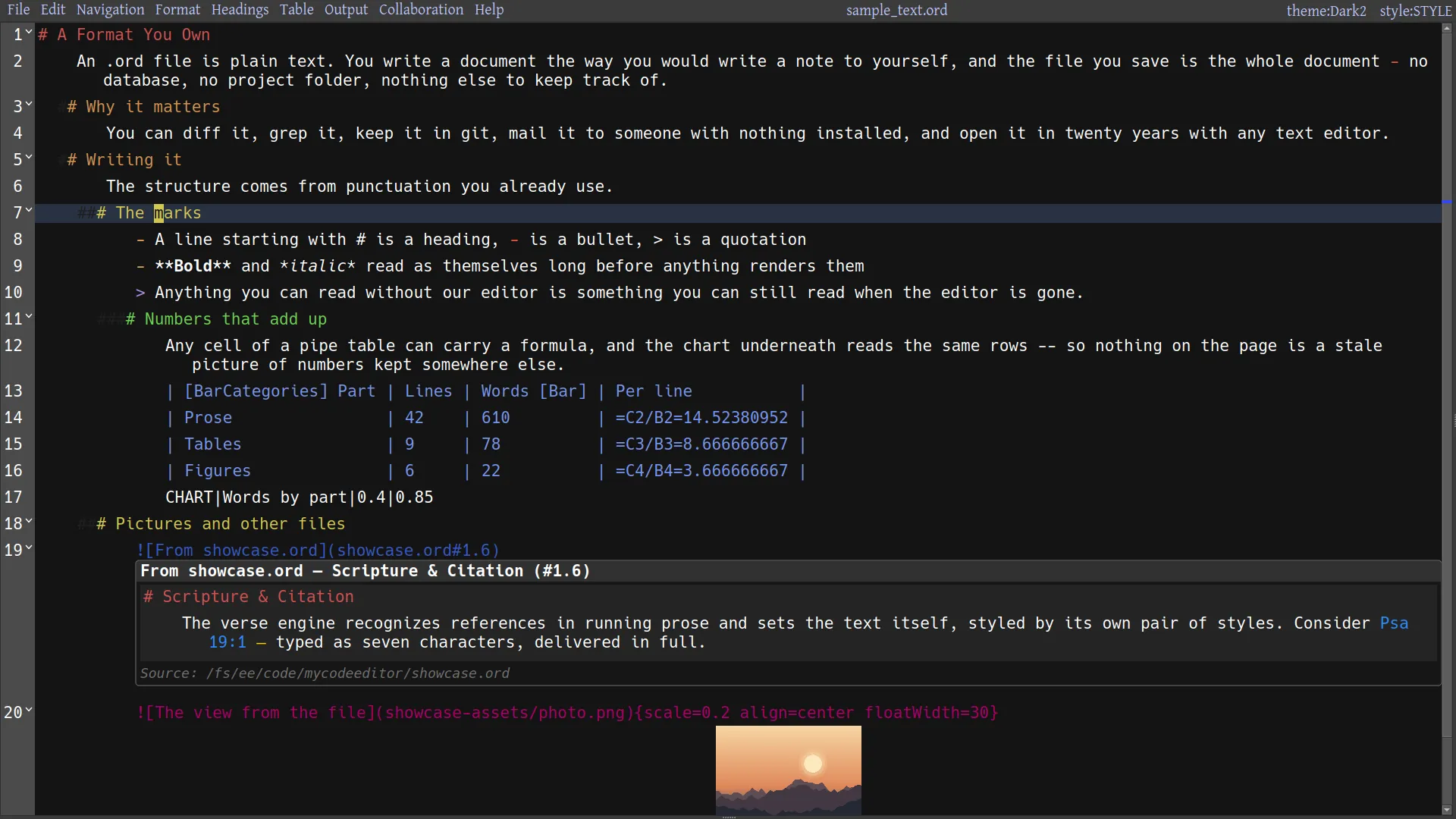
Documents are a simple, fully specified, Markdown-like plain-text format — diffable, git-friendly, greppable, easy for AI to read and write, and readable for generations to come. The entire history lives in the file: every edit, comment, and chat. No database, no cloud.

  • Plain-text format, fully specified and parsable — easy for AI to read and generate fully styled documents
  • Whole history, comments, and chats stored in the file itself
  • Output to PDF, single-file self-contained HTML (inline assets, print stylesheet), and OpenDocument (.fodt)
  • Fast preview in the editor
  • Embed or link content from other docs — build a knowledge system of linked documents
The editor showing a document as plain text: hash-marked headings, dashed bullets, a pipe table whose cells hold formulas, and a one-line reference to another .ord file with that file's section previewed underneath it
Fine-grained access control

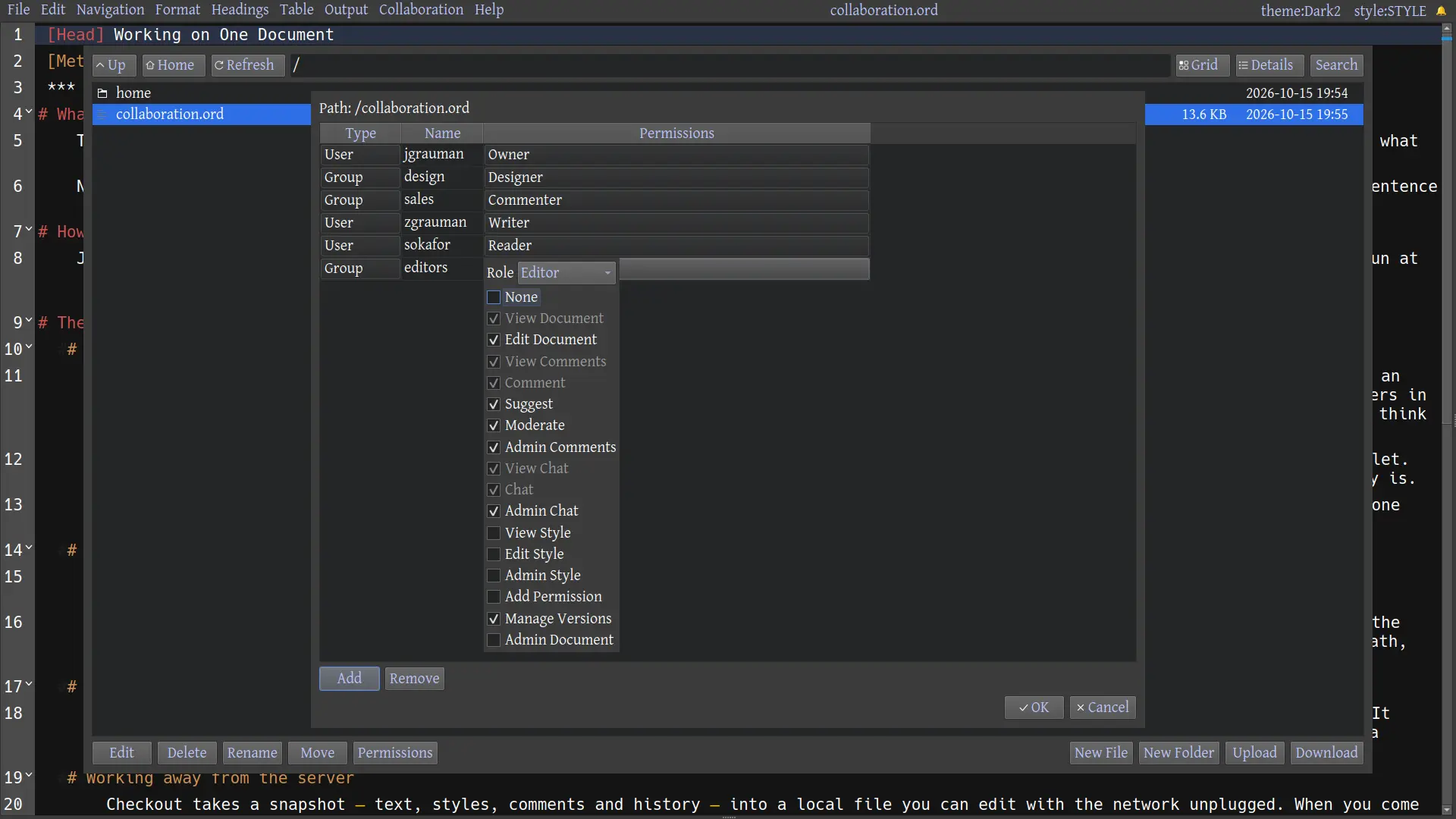
Roles & Permissions

A rich permission system with users, groups, folders, and document-level access controls — pick a ready-made role or combine permissions into your own.

  • Roles: Reader, Commenter, Reviewer, Writer, Designer, Editor, Owner — or your own mix of permissions
  • User and group management
  • Folder and document permissions
  • Style and settings tables lock per row or field while someone edits, so two people never overwrite each other
  • Secure SSL communication, PBKDF2-hashed credentials
The server file browser with a permissions dialog open over one document: groups and users each given a role (Owner, Designer, Commenter, Writer, Reader), and the editors group's checklist open with Role set to Editor above every right from View Document through Moderate, Admin Chat and Manage Versions

Ready to try it for yourself?

Every feature above is in the download, and all of it is free and unrestricted while the editor is in preview.